





In a state where politics has seeped into every corner of public life, even a school wall is no longer just a wall.
In Howrah’s Sankrail, a simple mural painted by students has suddenly become national news. On that wall, the faces of some of India’s most respected figures – Rabindranath Tagore, Netaji Subhas Chandra Bose, Dr Sarvepalli Radhakrishnan, and A.P.J. Abdul Kalam – look out at passers-by. These portraits were not commissioned by a political party or painted by professionals. They were drawn by schoolchildren of South Duilla High School, and for months local residents have quietly admired their work.
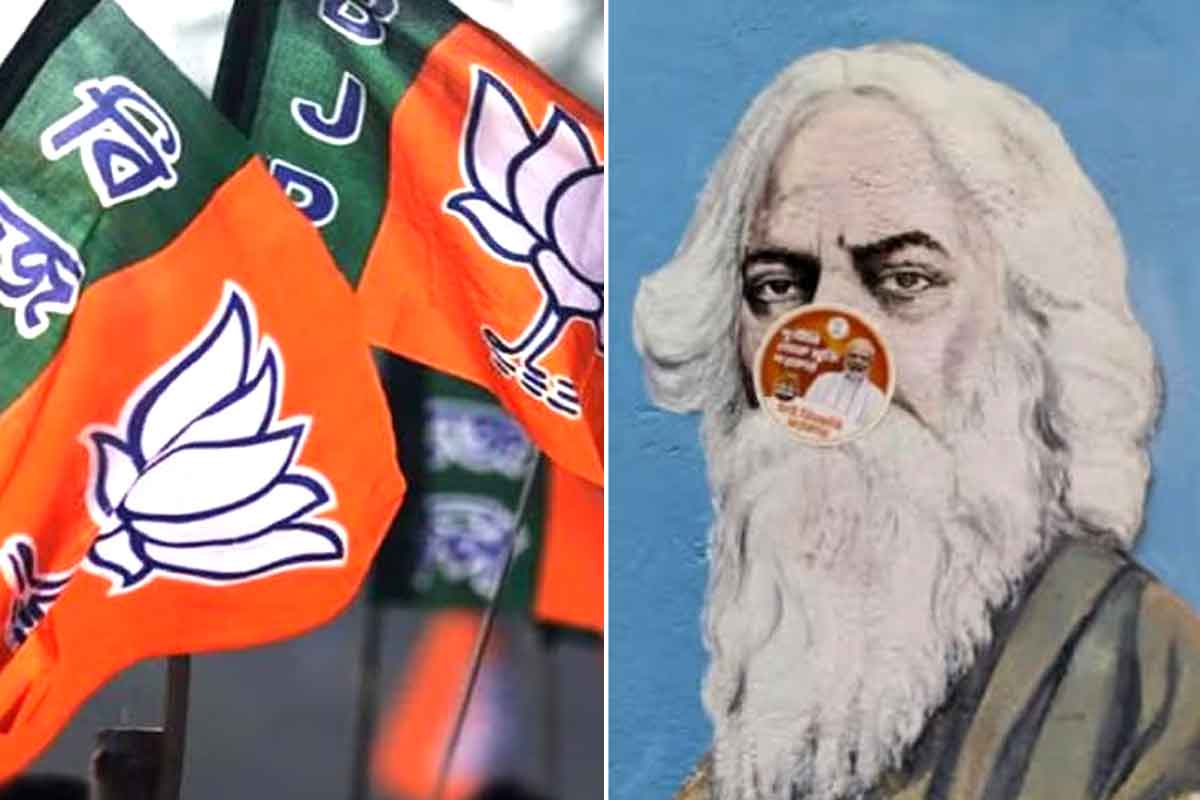
Then came politics – quite literally – stuck on the nose of the Nobel laureate.
BJP ‘Paribartan Yatra’ Sticker on Rabindranath Tagore Nose
A “Paribartan Yatra” sticker, belonging to the BJP’s political campaign, ended up right on the nose of Rabindranath Tagore’s image. One careless, or calculated, placement turned a wall painting into a political battlefield.
When a Sticker Becomes a Statement
On the surface, it’s “just” a sticker. But in Bengal, symbols matter. Tagore is not merely a poet here; he is an emotion, an identity, almost a civilisational anchor. To place a political campaign sticker on his nose is bound to be seen as more than a random act.
The photograph of the mural with the sticker on Tagore’s nose went viral on social media. Outrage followed instantly. Many saw it as yet another example of how Bengal’s icons are routinely dragged into party wars. For months, the BJP has been accused of showing disrespect to Bengali luminaries – from Bankim Chandra Chattopadhyay to Ramakrishna Paramhansa. This latest incident conveniently fit that narrative.
The anger was not just about a piece of paper. It was about the sense that political parties are now willing to occupy even our cultural icons, turning them into canvases for their slogans.
The School Caught in the Crossfire
According to the headmaster of South Duilla High School, the school authorities only got to know about the sticker from social media on Monday night. At closing time that day, no such sticker was seen on the mural. The obvious inference is that someone came at night and pasted it.
Inside the school, there are CCTV cameras, but there are none outside on the wall where the murals are painted. That conveniently leaves us with a mystery: we know what was done, we know when it was roughly done, but we do not know who did it.
By Tuesday morning, when the school reopened, the sticker had already vanished. The controversy, however, did not. The online furore ensured that the incident could not simply be erased by peeling off a piece of paper.
So, was this a genuine act by over-enthusiastic BJP workers? Or a deliberate ploy by rivals to plant the sticker, wait for the photograph, and then weaponise outrage? That question is now at the heart of the political blame game.
TMC’s Reaction: An Assault on Bengal’s Culture
The Trinamool Congress has wasted no time in turning this into a larger narrative about the BJP’s relationship with Bengal’s culture.
Howrah district TMC president Gautam Chowdhury condemned the incident sharply, arguing that the BJP simply does not understand Bengal’s heritage and cultural ethos. In his view, a party ignorant of Bengal’s core values cannot hope to “capture” the state.
Translated, the message is clear: if you disrespect Tagore, you do not deserve Bengal.
For the TMC, the timing is convenient. With the 2026 Assembly elections approaching, every symbolic fight counts. “Culture” versus “outsider politics” has been one of Mamata Banerjee’s core themes in recent years. The Tagore sticker incident fits perfectly into that storyline.
BJP’s Counter: A Framed Conspiracy?
The BJP, for its part, has rejected the allegations and tried to turn the story around. Howrah district BJP president Gauranga Bhattacharya has called it the handiwork of “talkative TMC workers” – alleging that Trinamool supporters themselves put up the sticker just to blame the BJP.
He insists that the BJP does not insult Bengali icons, but rather respects and honours them. In other words, the party is arguing that it is the victim of a political setup.
In today’s Bengal, this back-and-forth is almost formulaic:
- An incident occurs,
- one side calls it an insult to Bengal or democracy,
- the other side calls it a conspiracy by the ruling party,
- social media turns judge, jury, and executioner.
The result? The truth gets buried under layers of narrative.
The Larger Battle: Culture as a Political Weapon
What makes this incident important is not the sticker itself, but what it reveals about our political climate.
-
Icons as Battlegrounds:
Figures like Tagore, Netaji, and Vivekananda are shared national icons. Yet political parties now selectively claim them, quote them, and pose with their portraits while simultaneously fighting over who is the “real” heir to their legacy. -
School Spaces No Longer Neutral:
A school wall painted by children should have been the safest, most apolitical space. Instead, even that has been pulled into the vortex of electoral competition. -
Outrage as a Political Strategy:
Outrage has become a political resource. Whether it is genuinely felt or carefully manufactured, it is used to mobilise supporters and shape perceptions. A sticker on Tagore’s nose becomes a talking point in tea stalls, WhatsApp groups, and TV debates. -
Elections in the Background:
All of this is unfolding against the backdrop of the 2026 West Bengal Assembly elections. Campaigns like “Paribartan Yatra” are designed to project momentum and inevitability. Incidents like this can either energise a party’s base or damage its image, depending on how the story is told.
Respect Beyond Rhetoric
The tragedy is that in the noise of political accusations, the original spirit of the mural is forgotten.
Those portraits were painted by students – young minds who probably see Tagore and other national icons as sources of inspiration, not as tokens in a political chess game. Their artwork has now been dragged into a messy public brawl.
If we truly respect Rabindranath Tagore, that respect should go beyond lip service and campaign posters. It should mean:
- Leaving children’s art and school spaces out of partisan wars.
- Ensuring that our political messaging does not physically deface or overshadow cultural symbols.
- Having the courage to condemn such acts unequivocally, no matter which political colour is responsible.
But that would require a maturity that our current politics rarely displays.
Who Is Really Insulted?
The most common phrase used around this controversy is that Tagore has been “insulted”. Has he? Or have we simply exposed our own smallness?
Rabindranath Tagore’s legacy does not depend on what one party’s worker sticks on a wall. His place in history is beyond the reach of cheap tactics. What this incident truly exposes is not a threat to Tagore’s stature, but to our own capacity to handle dissent, symbolism, and electoral competition with dignity.
In the end, the real insult is not to Tagore, but to the idea of a civil public space – a space where art, education, and culture can exist without being swallowed by the hunger for votes.
Until we learn to keep that space sacred, we will keep seeing Tagore’s face – and the faces of many other icons – dragged into political mud-slinging, one sticker at a time.


