




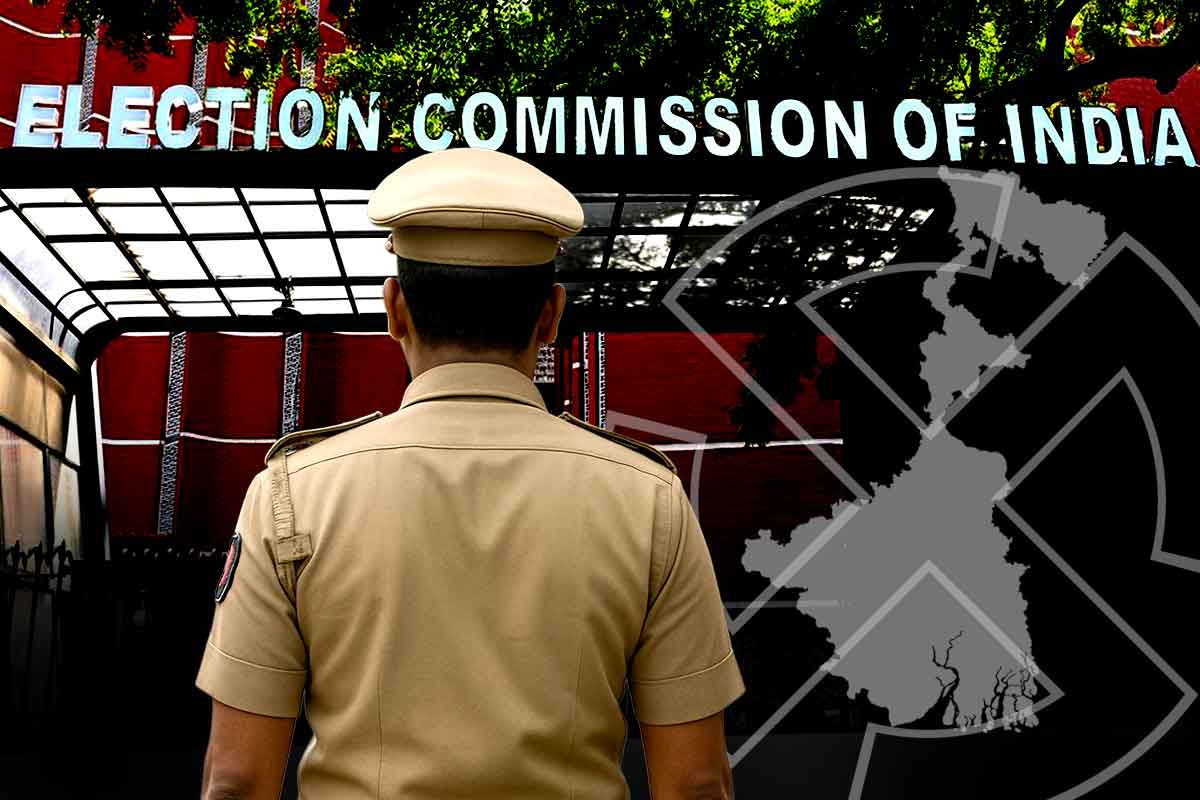
In a move that has once again put the spotlight on the Election Commission’s role in West Bengal politics, five Deputy Inspectors General (DIGs) have been transferred just before the 2026 Assembly elections. The timing and scale of the reshuffle have raised serious questions about intent, neutrality, and the larger political message being sent to the ruling establishment in the state.
This latest ‘action’ by the Commission comes on the very day the election dates were announced. Earlier, the Commission had already ordered the removal of the state’s Chief Secretary, Home Secretary, and several top police officials. Even Kolkata’s Police Commissioner, the Director General of Police (DGP), and multiple district Superintendents of Police (SPs) were replaced overnight. Chief Minister Mamata Banerjee has sharply criticised these decisions, alleging that the system is being remotely controlled to influence the electoral atmosphere in Bengal.
Yet, despite political objections from the state, the Commission has once again moved decisively—this time targeting five DIGs in key ranges.
According to the Election Commission’s notification, the following changes have been made:
- The DIG of Raiganj Range has been replaced. Rathore Amitkumar Bharat, an IPS officer of the 2009 batch, has been appointed as the new DIG of Raiganj Range.
- Ajit Kumar Yadav has been appointed as the DIG of Murshidabad.
- Shrihari Pandey has been made the DIG of Burdwan.
- Kankar Prasad Barui has taken charge as the DIG of Presidency Range.
- Anjali Singh has been appointed as the DIG of Jalpaiguri Range.
The Commission has instructed all five newly appointed DIGs to take charge by 11 AM on Thursday. Additionally, the state administration has been asked to submit a compliance report to the Election Commission once the transitions are complete.
What makes this entire exercise more contentious is the allegation that these decisions were taken without any meaningful consultation with the state government. For a federal democracy, such a unilateral approach inevitably triggers a political storm. The ruling party in Bengal views it as an intrusion into the state’s administrative autonomy, while the opposition frames it as a much-needed corrective step to ensure free and fair elections.
Beyond the DIG transfers, the Centre’s imprint on poll-time policing in Bengal is becoming ever more visible.
A Heavy Deployment of Observers
Alongside the reshuffle in the police hierarchy, a significant contingent of police and election observers is being deployed across West Bengal. A total of 84 Police Observers are arriving in the state, drawn from various parts of the country including Bihar, Telangana, Delhi, Punjab, and other states. Their mandate is clear: oversee law and order and ensure that the state machinery functions strictly within the framework laid down by the Election Commission.
In addition, the Commission has appointed one General Observer for each Assembly constituency—294 in total. These General Observers will monitor the overall conduct of the elections on the ground, from campaigning and polling to counting.
The Commission has also sharply increased the number of Expenditure Observers. Their task is to scrutinise election spending, track the flow of money, and check whether candidates and parties are violating expenditure limits or trying to influence voters with cash and gifts. According to available information, Police Observers, General Observers, and Expenditure Observers are all expected to reach West Bengal by Wednesday itself.
What Does This Signal Politically?
Taken together, these moves send a very clear signal: the Election Commission does not appear willing to rely solely on the existing state apparatus in West Bengal. Instead, it is rebuilding the top layer of the police force and parachuting in officers and observers from outside the state. Supporters of the move argue that given Bengal’s history of political violence and allegations of partisan policing, such strong intervention is necessary to restore public confidence.
Critics, however, see something deeper and more troubling. When the Chief Secretary, Home Secretary, Kolkata Police Commissioner, DGP, SPs, and now five DIGs are all changed around the same time, it looks less like routine administrative reshuffling and more like a deliberate political message. To many in the ruling camp, the message is unmistakable: the state government’s control over its own law-and-order machinery is being systematically diluted during the election period.
The debate, ultimately, is not just about individual officers. It is about trust—trust in the Election Commission as an independent body and trust in the federal balance of power between the Centre and the states. Each transfer order, each new observer deployment, intensifies that debate.
As West Bengal heads towards the 2026 Assembly elections, the administrative battlefield is clearly being prepared long before a single vote is cast. Whether this leads to a genuinely freer, more peaceful election, or deepens the perception of political interference, will depend not only on the Commission’s decisions but also on how fairly and transparently those decisions are implemented on the ground.
One thing, however, is already evident: these five DIG transfers are not just bureaucratic files being shuffled. They are part of a much larger political script being written in Bengal ahead of a fiercely contested election.