





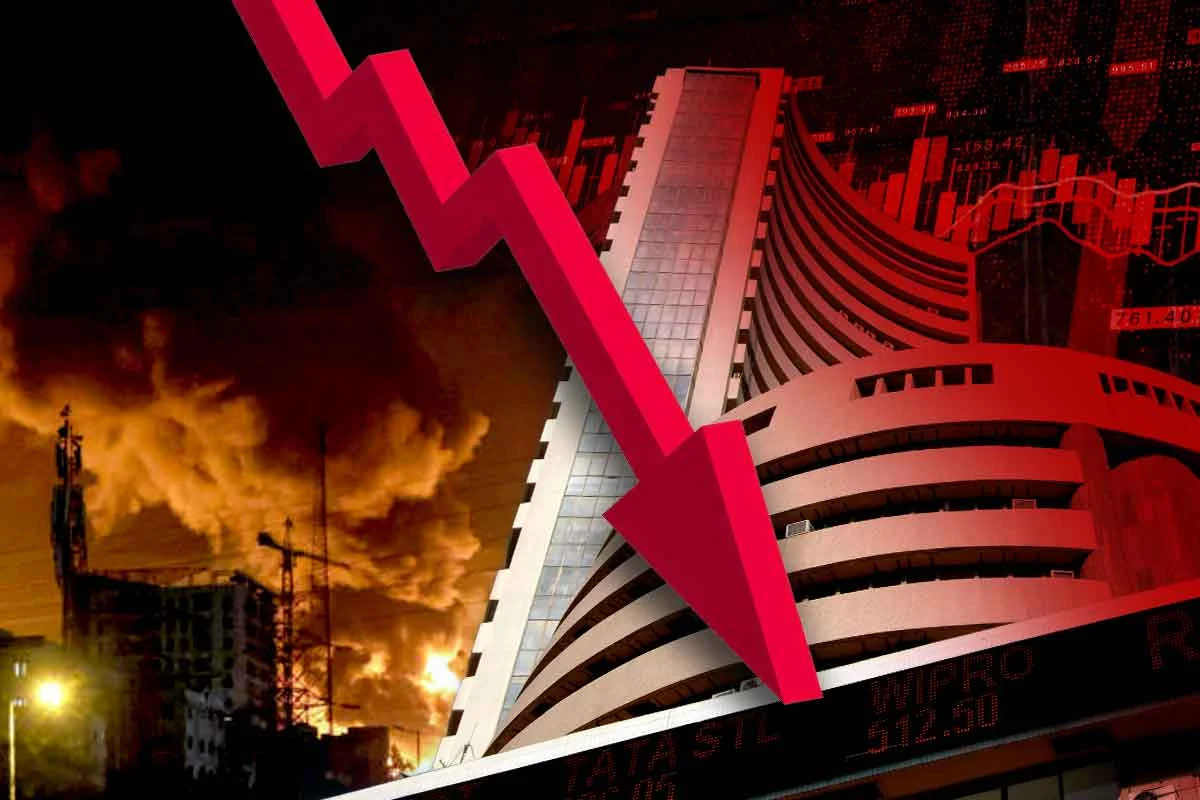
Introduction India’s stock market came under intense selling pressure as geopolitical tensions in West Asia spilled over into global financial markets. On Thursday, the Sensex crashed by about 1,500 points and the Nifty fell 488 points after international crude oil prices surged past $110 per barrel. The sharp rise in oil prices, driven by the ongoing Iran–Israel conflict and disruption near the Strait of Hormuz, has raised serious concerns about inflation, the rupee, and the overall health of the Indian economy.
Market Rally Turns into a Sudden Crash Despite the war-related uncertainty, Indian equities had been surprisingly resilient over the previous two trading sessions. The Sensex had gained 633.29 points on Wednesday and, over the last three trading days, had risen around 2,140 points to touch approximately 76,704.80.
However, this positive momentum reversed sharply on Thursday. As the market opened, both the Sensex and the Nifty turned decisively lower, with heavy selling across sectors. The Sensex slipped by about 1,500 points, while the Nifty fell around 488 points, reflecting sudden risk aversion among investors as oil prices spiked further.
Why Crude Oil Prices Are Surging The key trigger behind the stock market crash is the sharp rise in global crude oil prices:
- International benchmark crude crossed $110 per barrel.
- The Strait of Hormuz, a critical chokepoint for global oil and gas supply, has been disrupted due to the ongoing conflict in West Asia.
- For India, which imports a large share of its crude oil, this surge has immediate economic consequences.
Reports indicate that the price of the crude oil basket that India typically imports has jumped to around $146.1 per barrel. This steep increase has alarmed policymakers and market participants, as it directly raises India’s import bill and widens the current account deficit.
Impact on the Indian Economy Experts warn that sustained high crude prices could push India’s inflation significantly higher. Some estimates suggest that inflation could rise to around 5.5% if current trends continue. This has several implications:
-
Higher Import Bill
- India’s dependence on imported crude means that every jump in oil prices immediately increases the country’s import costs.
- This puts pressure on the fiscal balance and may force the government to choose between absorbing some of the costs or allowing full pass-through to consumers.
-
Risk of Fuel Price Hikes
- Retail prices of petrol, diesel, and LPG are likely to move higher if crude remains elevated.
- State-owned oil marketing companies have already increased cooking gas prices, citing the impact of the war and higher input costs.
-
Rising Inflation
- Higher fuel prices feed into the cost of transportation, logistics, and production, ultimately pushing up the prices of essential goods and services.
- If inflation climbs towards or beyond 5.5%, it could affect household budgets and consumer sentiment.
-
Pressure on the Rupee
- The rupee has weakened further against the US dollar.
- The exchange rate has moved closer to ₹93 per dollar, with recent trades around ₹92.89.
- A weaker rupee makes imports more expensive and can add another layer of inflationary pressure.
Geopolitical Backdrop: Iran–Israel Conflict and Hormuz Strait The current turmoil in global markets is closely linked to the escalating conflict involving Iran and Israel. The Strait of Hormuz, located near Iran, is one of the world’s most important maritime routes for crude oil and liquefied natural gas (LNG).
Due to the hostilities and security concerns in the region:
- Shipping routes have been disrupted.
- Insurance and freight costs have gone up.
- Traders have priced in a supply risk, pushing crude prices sharply higher.
For India, which relies heavily on energy imports from this region, any prolonged disruption near Hormuz is a strategic and economic concern. It threatens energy security, raises costs, and feeds volatility into domestic markets.
Investor Sentiment and Market Outlook The sudden correction in the Sensex and Nifty highlights how sensitive Indian markets are to global geopolitical and commodity shocks. Key points for investors to note:
- Volatility likely to remain high: As long as the Iran–Israel conflict and tensions around the Strait of Hormuz continue, global risk sentiment may remain weak.
- Sectoral impact: Oil marketing companies, aviation, logistics, and other fuel-intensive sectors are especially vulnerable to sustained high crude prices.
- Policy response: Investors will closely watch the Reserve Bank of India (RBI) and the government for any signs of policy support or intervention if inflation continues to rise and growth expectations weaken.
At the same time, some analysts believe that if tensions ease and crude prices retreat, Indian equities could recover, given the underlying domestic growth story. However, in the near term, the bias remains cautious.
Conclusion The crash in the Sensex by 1,500 points and the drop of 488 points in the Nifty underline how quickly global developments can reshape India’s financial landscape. With crude oil crossing $110 per barrel and the Indian crude basket nearing $146, worries about inflation, the rupee, and economic growth have intensified.
Until there is clarity on the Iran–Israel conflict and the security of energy supplies via the Strait of Hormuz, investors should be prepared for continued volatility in the Indian stock market. Monitoring crude oil prices, currency movements, and policy signals will be crucial for anyone tracking or participating in the markets during this uncertain period.