






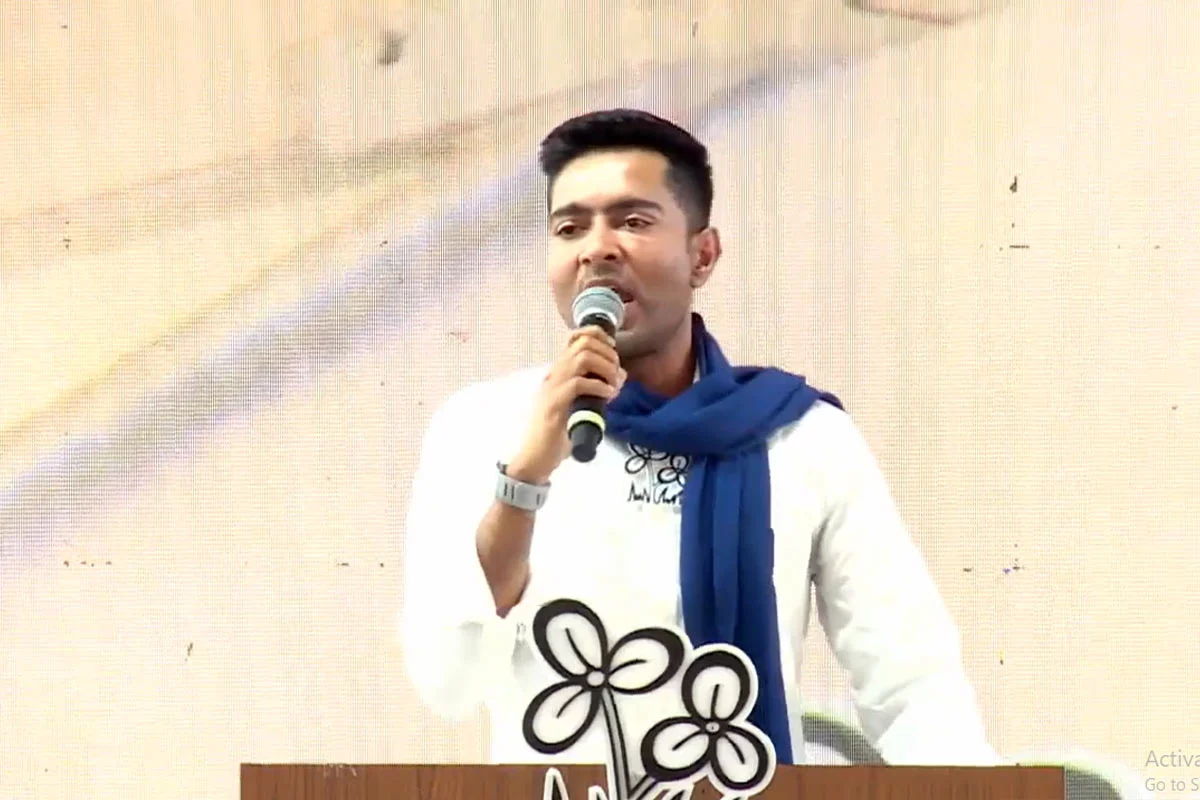
In a sharp escalation of the political battle ahead of the 2026 West Bengal Assembly election, Trinamool Congress (TMC) national general secretary Abhishek Banerjee on Wednesday claimed that the Bharatiya Janata Party (BJP) is desperately trying to poach Trinamool’s booth-level agents with cash offers routed from Delhi.
Addressing a packed rally at Jagannathpur in the Daspur Assembly segment of Paschim Medinipur, Abhishek Banerjee alleged that the BJP does not have enough ground workers to man polling booths in Bengal, and is therefore attempting to weaken the Trinamool’s organisational strength.
“Many of our booth-level agents, who are connected with my office, have told me that they are getting calls from the BJP’s Delhi office,” Abhishek said from the stage. “They are being told, ‘You’ve done enough for Trinamool, now stop’.”
According to him, these calls are being made to BLA-2s (Booth Level Agents) of the Trinamool Congress — the party’s second line of booth defence — who play a crucial role in safeguarding votes at the grassroots.
‘BJP’s money, TMC’s votes’
Turning the alleged BJP tactic on its head, Abhishek Banerjee advised Trinamool workers not to be intimidated and instead treat such phone calls as proof of the party’s strength under Chief Minister Mamata Banerjee.
He suggested that if any TMC booth-level agent receives an offer of money from BJP functionaries, they should keep bargaining up — but remain loyal to the Trinamool Congress at the time of voting.
“If they offer you ₹2,000, bargain and ask for ₹5,000,” he said. “If they agree to ₹5,000, push it to ₹10,000. And if they offer ₹10,000, ask for ₹50,000. Because that money is actually yours, it is people’s money. Take BJP’s money, but when you go to the polling booth, cast your vote for the Trinamool’s ‘Jora Phool’ (twin-flower symbol).”
The remark drew loud cheers from the crowd, as Abhishek attempted to portray the BJP as a party forced to rely on money power in the absence of genuine organisation in Bengal’s villages and towns.
Campaigning for TMC’s Daspur candidate
Abhishek Banerjee was in Daspur to campaign for Trinamool candidate Ashis Hudait, as the state prepares for polling in two phases, on 23 April and 29 April.
Positioning the election as a choice between what he called Mamata Banerjee’s proven model of development and alleged “conspiracies scripted in Delhi”, Abhishek urged voters in Daspur to back the TMC to “defend Bengal’s dignity and development.”
Mamata’s ‘Ten Pledges’ and Laxmi Bhandar
Reiterating the Trinamool’s ‘Ten Pledges’ for the people of Bengal, Abhishek Banerjee focused especially on schemes that have become central to Mamata Banerjee’s welfare-driven politics. One of the flagship programmes he highlighted was Laxmi Bhandar, the direct benefit transfer scheme for women.
He assured that under Mamata Banerjee’s leadership, women of Bengal will continue to receive Laxmi Bhandar support throughout their lives, describing it as a recognition of the unpaid labour and contribution of women to both family and society.
Abhishek also took on the BJP over its attitude towards welfare schemes, accusing the party of trying to undermine the financial independence of women.
He referred to a recent incident in Daspur where, he alleged, a local BJP leader had urged that women receiving Laxmi Bhandar benefits be confined to their homes on polling day. “Even after such a shocking statement, the BJP took no action against that leader,” Abhishek said, branding the party as “anti-women and anti-poor”.
Development under Mamata Banerjee: Ghatal Master Plan in focus
Apart from political attacks, Abhishek Banerjee used the platform to list what he described as concrete achievements of the Mamata Banerjee government in Paschim Medinipur and across the state.
He cited the Ghatal Master Plan and other infrastructural and development projects as examples of how the Trinamool government has worked to improve people’s lives on the ground. Although successive central governments had been accused of ignoring the recurring floods in the Ghatal region, the TMC leadership has often highlighted Mamata Banerjee’s efforts to push for lasting solutions.
From rural roads and irrigation to health, education, and welfare schemes, Abhishek argued that the Trinamool’s track record stands in clear contrast to what he called the BJP’s “politics of polarisation and intimidation”.
‘Delhi script vs Bengal’s mandate’
Casting the 2026 West Bengal Assembly Election as a battle between Delhi’s centralised political script and Bengal’s own mandate, Abhishek Banerjee claimed that the BJP is trying to run Bengal “by remote control” from its national headquarters.
He insisted that decisions about West Bengal should be made by its own people and their elected representatives in Kolkata’s Nabanna, not by what he termed “phone calls from Delhi” seeking to manipulate booth-level dynamics.
Eyes on Nabanna: Bengal heads towards 2026 polls
With just weeks to go before the two-phase polling, both the ruling Trinamool Congress and the BJP have intensified their campaigns. While the BJP is banking on national leadership and central agencies, the TMC is leaning heavily on Mamata Banerjee’s welfare schemes, regional pride, and grassroots organisation.
Abhishek Banerjee’s Daspur rally underscores the Trinamool’s strategy: to expose what it calls the BJP’s “conspiracies”, reinforce the emotional appeal of Mamata Banerjee’s leadership, and mobilise booth-level workers as the first line of defence for the party’s vote.
For more updates and in-depth coverage of the West Bengal Assembly Election 2026, keep an eye on it

