




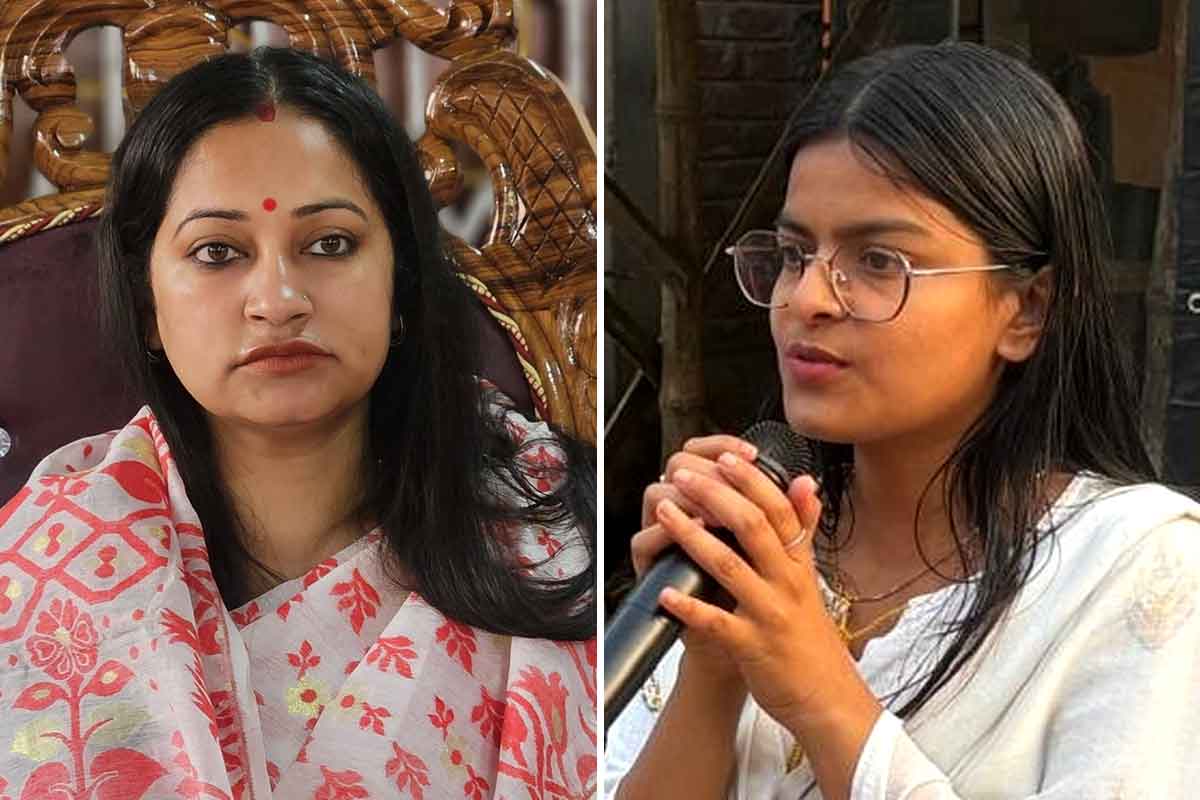
The political battle in West Bengal’s Bagda Assembly constituency has taken on a distinctly personal tone this time. The BJP has announced Union Minister and Bongaon MP Shantanu Thakur’s wife, Soma Thakur, as its candidate from Bagda. On the other side stands Madhurparna Thakur, the sitting MLA from the Trinamool Congress (TMC) and daughter of Mamata Thakur, a prominent face of the Matua community.
What might look like a straightforward electoral contest is, in reality, a complex mix of family equations, local aspirations, and party strategies. And in that mix, the BJP’s candidate selection appears to have sparked discontent within its own ranks – a development that could quietly strengthen the TMC’s position on the ground.
BJP Fields Soma Thakur, Triggers Grassroots Resentment
On Tuesday morning, the BJP released its list of candidates for 13 Assembly seats in West Bengal, naming Soma Thakur as the party nominee for Bagda. Though she has been visible in campaigns earlier – especially during the last Lok Sabha election in support of her husband Shantanu Thakur – Soma herself has not been a long-time active player in frontline electoral politics.
Her elevation as the BJP candidate has not gone down well with sections of the local party organisation. According to reports, a sizeable part of the BJP’s grassroots cadre in Bagda had been openly demanding a local face as candidate. Social media posts, local campaigns, and internal appeals had all highlighted one demand – representation from within the area.
Yet, the state leadership chose otherwise. The decision to field Soma Thakur is widely being seen as a top-down choice, more aligned with family influence and Delhi–centric calculations than with the sentiments of the booth-level workers.
The result: visible anger and disappointment among BJP workers, with some openly hinting at a silent protest through the ballot box.
TMC’s Madhurparna Thakur: Continuity, Local Connect, and Community Trust
In contrast, the Trinamool Congress has reposed its faith once again in Madhurparna Thakur, a relatively young but already established face in Bagda. She belongs to the historic Thakur family and is recognised as one of its younger, active members who took on electoral responsibility when the seat went for a bypoll.
In that by-election, Madhurparna registered a comfortable victory, reinforcing the TMC’s strong presence in this Matua-dominated region. Her profile blends community connect, local visibility, and the credibility of performance as a sitting MLA. Since then, she has continued engaging with people on the ground, addressing local issues and strengthening her personal equation with voters.
By re-nominating Madhurparna, the TMC has sent a clear message of stability and continuity. At a time when voters across Bengal are increasingly attentive to who stands by them beyond election season, this consistency in candidate selection could prove to be a major asset.
Matua Heartland: Why Bagda Matters
Bagda is considered an important segment of the Matua heartland, a region where community identity and long-standing demands carry deep political significance. Over the past several years, both national and state-level parties have tried to position themselves as champions of Matua rights, especially on issues like citizenship, dignity, and development.
In 2021, the BJP’s Biswajit Das won this seat convincingly on a saffron wave. However, his later defection to the TMC and subsequent Lok Sabha attempt – where victory eluded him – added another layer of political flux to the region.
When the bypoll was called, the TMC gave responsibility to Madhurparna Thakur, who went on to deliver a strong victory for the party. Her success hinted that voters in this Matua-dominated constituency respond not just to slogans and big promises, but to trust, accessibility, and community-centric leadership.
As West Bengal moves towards the 2026 Assembly elections, Bagda once again becomes a symbolic arena: Will voters back TMC’s continuity and local connect, or reward the BJP’s new experiment with family-based candidacy?
Internal Rumbles in BJP: A Self-Inflicted Challenge?
Perhaps the most striking development following the announcement of Soma Thakur’s candidature has been the open and simmering resentment among the BJP’s lower and mid-level functionaries in Bagda.
Many had been strongly advocating for a candidate rooted in the constituency’s everyday realities – someone seen as truly local, rather than a name chosen by the top brass. Posts on Facebook and comments in local circles have repeatedly pointed out this demand. However, these appeals, workers claim, were ignored by the party’s senior leadership.
In response, some disgruntled leaders and karyakartas have issued veiled warnings:
“We repeatedly requested a local candidate. We were not heard. This time, the result will speak in the voting booth.”
Such a mood, if it persists, could fragment the BJP’s vote base, slow down its campaign momentum, and inadvertently give the TMC an edge – especially if the Trinamool camp can maintain unity and avoid similar internal rifts.
TMC’s Advantage: United Front Versus Divided Opposition
While the BJP grapples with questions over candidate selection and internal democracy, the TMC in Bagda appears more cohesive and campaign-ready. With Madhurparna Thakur already on the ground and experienced from her bypoll win, the party machinery has a head start.
A few factors currently seem to tilt the balance subtly in the TMC’s favour:
-
Incumbent Advantage
As the sitting MLA, Madhurparna can directly point to her record, ongoing projects, and outreach. Voters often respond positively to continuity if they feel visible work has been done. -
Community Connect
Being from the Thakur family and already tested in a Matua-majority constituency, she is seen by many as someone who understands local customs, concerns, and aspirations. -
Organisational Unity
Unlike the visible fractures in the BJP camp, the TMC unit in Bagda has so far projected a relatively united front behind a single, familiar face. -
Contrast in Candidate Profiles
Where the BJP appears to have imposed a top-down, family-linked choice, the TMC’s decision feels more like a continuation of a bond forged with the electorate through the bypoll.
In an election where margins can be narrow, such factors can quietly yet powerfully influence outcomes.
Family Politics vs Local Aspirations
The Bagda contest symbolises a larger debate playing out across Indian politics: Should seats be decided by family ties and high command interests, or by grassroots sentiment and local representation?
By fielding Soma Thakur, the BJP seems to be banking heavily on the influence of Shantanu Thakur and the larger Thakur family network, hoping that the surname and family identity will be enough to mobilise support. However, the backlash from local workers suggests that symbolism alone may not suffice if it comes at the cost of internal democracy.
The TMC, on the other hand, has also chosen a member of the same extended family, but with a crucial difference:
- Madhurparna has already earned her mandate once through the ballot,
- has built a track record as an MLA, and
- is perceived in many quarters as a working representative, not just a symbolic name.
This shifts the narrative from pure dynasty to performance, continuity, and local acceptance.
What This Means for the 2026 Assembly Elections
As West Bengal heads toward the 2026 Assembly elections, the developments in Bagda may carry a message larger than just one seat:
- For the BJP, ignoring the voices of local cadres in favour of a family-centric candidate risks creating a trust deficit, not only with voters but with its own workers.
- For the TMC, the situation offers an opportunity to highlight its relatively stable leadership in Bagda, its emphasis on continuity, and its willingness to stand by a sitting MLA who has already delivered.
Bagda could thus emerge as a case study in how organisational unity, candidate selection, and community connect can shape electoral fortunes.
Conclusion
The upcoming contest between BJP’s Soma Thakur and TMC’s Madhurparna Thakur is more than a personal face-off between two members of the same extended family. It reflects deeper themes of local aspirations, internal party democracy, and the real meaning of representation in Bengal’s evolving politics.
While the campaign has only just begun, the signs of resentment within the BJP’s local ranks and the TMC’s decision to place continued trust in a tested MLA suggest that the ruling party may quietly enjoy a strategic advantage in Bagda.
In a Matua-dominated seat where history, identity, and daily struggles intersect, voters will ultimately decide which leadership has truly listened to them – not just in the heat of the campaign, but in the years in between.