





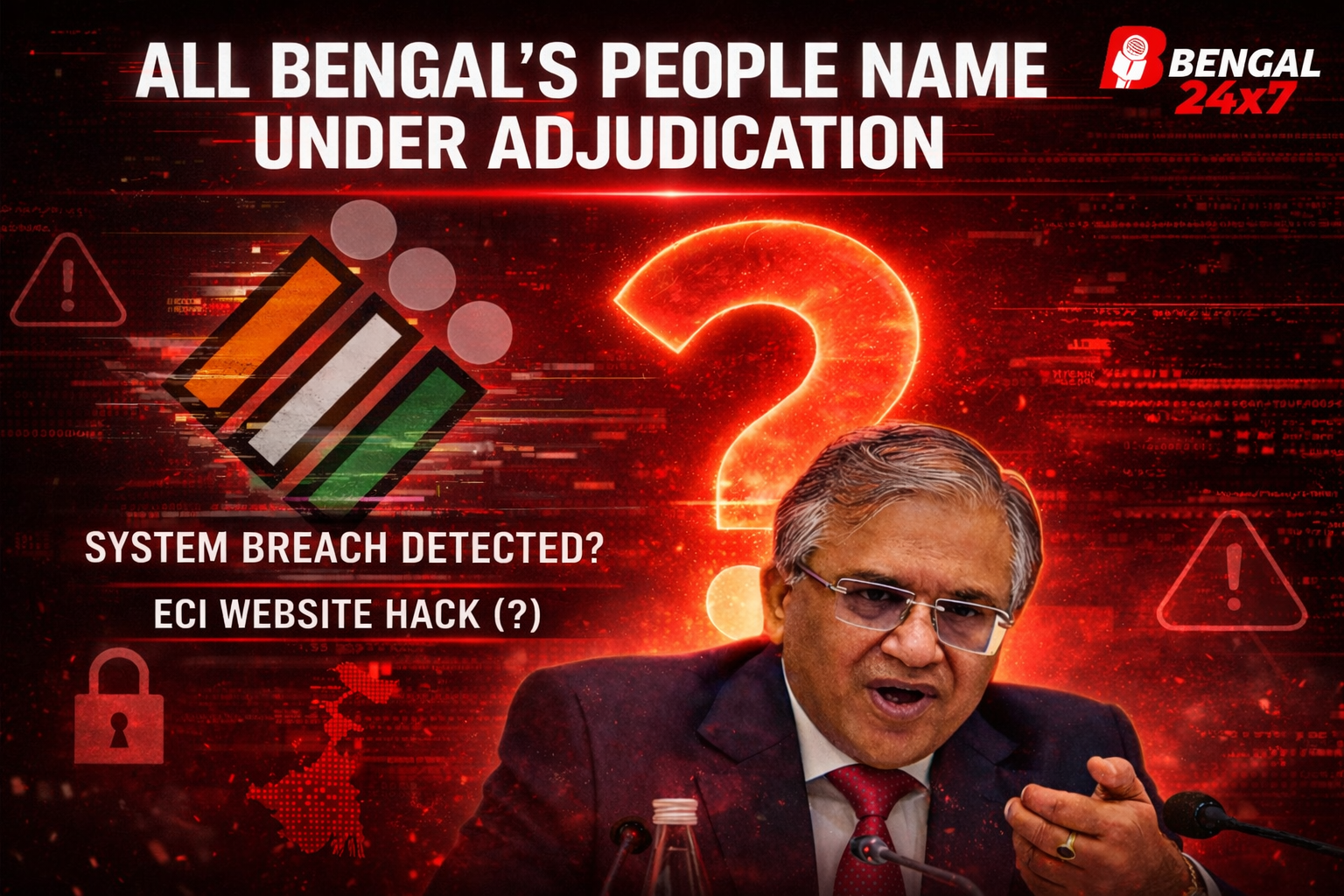
In a dramatic turn of events that has shaken political circles in West Bengal, a technical glitch on the Election Commission of India’s (ECI) voter portal briefly showed that all voters in the state were “under adjudication.” The incident has sparked a wave of outrage, serious questions about the ECI’s preparedness, and renewed attacks from the ruling Trinamool Congress (TMC) on the Commission’s credibility.
What Exactly Happened?
According to reports, after the publication of the final electoral roll on 28 February, it was found that around 60 lakh voters’ names were listed as “under “adjudication”—meaning their entries were still under verification or dispute.
In the last few days, the Commission reportedly disposed of nearly 30 lakh such cases, bringing down the number of pending adjudications. However, on Tuesday night, visitors to the ECI’s voter service portal voters.eci.gov.in were stunned to see that every single voter in West Bengal appeared as “under adjudication.”
This visual on the official platform immediately triggered confusion and panic among citizens and political workers alike. Social media began to buzz with screenshots and allegations, and the issue quickly snowballed into a full-blown political controversy.
ECI Blames a ‘Technical Error’
Faced with growing criticism, the Election Commission authorities clarified that the anomaly was the result of a technical glitch on the voters.eci.gov.in website. They maintained that other internal databases and official systems were functioning correctly, and that the problem was limited to the display on this particular site.
An ECI official stated that the matter was being examined and that the correct data was restored after some time. However, the damage to public confidence – especially in a politically sensitive state like West Bengal – had already been done.
TMC Questions ECI’s Credibility
The Trinamool Congress seized the opportunity to attack the Election Commission, accusing it of administrative failure and warning of the consequences such errors could have on free and fair elections.
West Bengal Chief Minister Mamata Banerjee stated that after the finalist list was published last night, all names suddenly showed a status of “Under Adjudication.” She added that upon searching her own name, she found the same issue.
When questioned, authorities reportedly claimed that the website had been hacked. Responding to this, the Chief Minister raised concerns, questioning how anyone could have the audacity to hack such an official platform.
TMC MP Mahua Moitra was among the most vocal critics. Targeting the Commission, she sharply asked whether the country’s electoral process had been reduced to a mere experiment.
Her pointed question – “Is this a game?” – summed up the frustration of many in the ruling party, who have long accused the ECI of bias and mismanagement in matters related to West Bengal.
Why Are Bengal’s People Suffering for ECI’s Failure?
Beyond the immediate political blame game, the incident raises a larger and more serious question: Why should ordinary voters in Bengal suffer due to the ECI’s administrative and technical failures?
For a common voter, seeing their status marked as “under adjudication” can mean:
- Fear that their name may be deleted or blocked from the electoral roll.
- Anxiety about whether they will be able to cast their vote in the upcoming elections.
- A feeling of insecurity and mistrust towards the very institution tasked with safeguarding democracy.
In a state with a history of intense electoral battles, allegations of voter suppression, and frequent clashes between rival parties, any irregularity in the voter list is not just a minor technical issue – it becomes a sensitive political weapon.
Administrative Accountability: Is ECI at Fault?
The Election Commission is expected to operate with high levels of accuracy, transparency, and reliability. When its own online systems display misleading or incorrect information about voter status, the responsibility ultimately rests with the Commission.
Key questions that now demand serious answers include:
- How could such a sweeping error occur on an official voter portal?
- Were there adequate checks and safeguards before updating or pushing data live to the public website?
- What immediate steps will be taken to ensure this does not happen again, especially with critical elections approaching?
By dismissing the problem as a mere “technical glitch,” the ECI risks appearing casual and unaccountable in the eyes of the public. In a democracy, even a short-lived error affecting the entire voter base of a state is simply unacceptable.
Political Fallout in Bengal
Unsurprisingly, the opposition and the ruling party have both used this episode to reinforce their respective narratives.
- The TMC is using the issue to question the neutrality and competence of the Election Commission.
- The BJP and other parties may counter that the glitch has now been resolved and accuse the TMC of politicising a technical matter.
Yet, regardless of party lines, one fact remains: trust in electoral institutions is non‑negotiable. Any lapse – technical or administrative – directly weakens that trust.
What It Means for Democracy
The strength of any democracy lies in the confidence of its citizens that their vote counts and that the systems handling their data are dependable. When a state wakes up to the news that all its voters are, even briefly, “under adjudication,” that confidence is badly shaken.
For the people of Bengal, this episode feels like yet another reminder that they are paying the price for institutional neglect and technical mismanagement. It is not just a website error; it is a symbolic failure of administrative responsibility at the highest level of election management.
Until the Election Commission provides a transparent explanation and outlines concrete corrective measures, questions will continue to be raised:
- Can voters fully trust what they see on official platforms?
- Are similar glitches happening in other states without public notice?
- And most importantly, who will be held accountable when such failures put the credibility of the electoral process at risk?
For now, one thing is clear: the controversy over Bengal’s voters being shown as “under adjudication” is far from a routine technical issue. It has become a political flashpoint – and a serious warning sign about the health of electoral administration in India.