





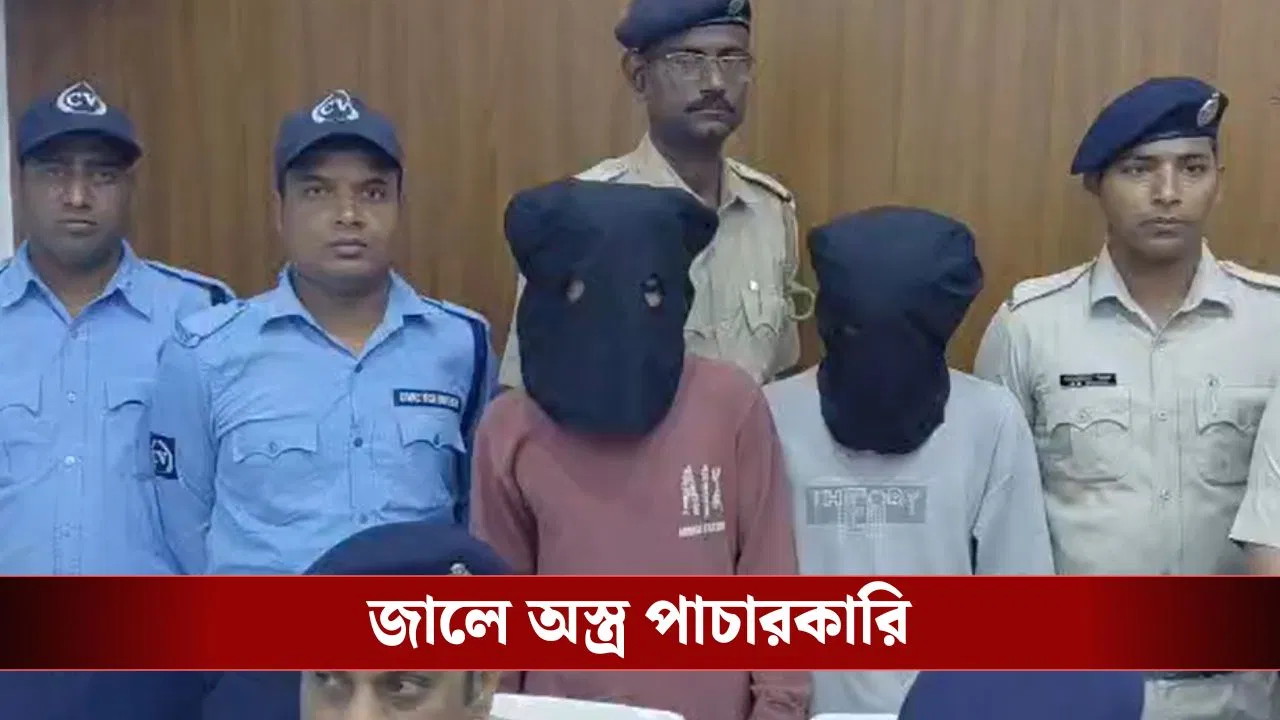
With the West Bengal Assembly Election 2026 drawing closer, a serious security and political controversy has erupted after Malda district police caught five men from Bihar allegedly smuggling firearms into Bengal.
According to police sources, the incident took place near the Nalakuthia area close to the Bihar border under the jurisdiction of Chanchal police station in Malda district. During an intensified naka-checking drive on the inter-state border, officers intercepted five suspicious individuals and, upon searching them, reportedly recovered:
- One 7 mm pistol
- Two country-made one-shotter firearms
- Four rounds of live cartridges
All five accused are residents of Bihar’s Katihar district. They have been identified as:
- Amit Kumar Saha
- Ganesh Mahaldar
- Sukhdev Saha
- Mohammed Riazul
- Mohammed Aman
Malda Superintendent of Police Anupam Singh stated that the weapons were being brought from Bihar to West Bengal with the “clear intention of sale.” The accused was produced before the Malda district court.
Political Angle: What Is the Bihar Government Doing?
The arrests have sharpened the political focus on the law and order situation in Bihar and the effectiveness of its government in curbing the illegal arms trade. The fact that an organised group from Bihar could allegedly move weapons toward poll-bound West Bengal raises uncomfortable questions:
- How are illegal firearms being manufactured, stored, or moved within Bihar without being detected?
- What measures has the current Bihar government taken to crack down on inter-state arms syndicates?
- Why are Bihar-based networks repeatedly surfacing in arms seizures linked to West Bengal and Jharkhand?
Opposition parties are likely to use this incident to question whether the Bihar administration is doing enough to dismantle arms trafficking routes that reportedly operate from districts like Katihar and spread their network into neighbouring states.
Impact on West Bengal’s Political Narrative
In West Bengal, where security has already been tightened ahead of the Assembly polls, this case feeds directly into the political narrative around violence, border security, and free and fair elections.
Authorities have stepped up checking along:
- The India–Bangladesh border areas in Malda district
- The Bihar–Bengal inter-state border
This latest recovery from alleged Bihar-based smugglers will likely be cited by political parties in Bengal to:
- Demand stricter coordination with Bihar Police
- Question how arms from outside the state are allegedly entering just before elections
- Accuse rivals of trying to influence the electoral process through intimidation and muscle power
Recent incidents, including earlier arrests by Kolkata Police’s Special Task Force of arms smugglers from Bihar and Jharkhand, have already underlined how Bengal has become a destination market for weapons sourced from neighbouring states.
Pattern of Arms Seizures: A Regional Security Concern
The Malda arrests do not stand alone. In the past few months:
- Kolkata Police STF has arrested multiple arms peddlers allegedly linked to Bihar and Jharkhand.
- Several one-shotter guns and revolvers have been recovered in different operations, adding to concerns of a wider network.
Taken together, these cases reveal a pattern:
- Source regions: Districts in Bihar and Jharkhand repeatedly figure in charge sheets and FIRs.
- Transit & destination: West Bengal, especially during politically sensitive periods like elections, appears frequently as the destination.
This raises deeper policy-level questions for both state governments and the Union government:
- Are current intelligence-sharing mechanisms between Bihar, West Bengal, and Jharkhand sufficient?
- Are there political pressures or local vested interests that slow down decisive action against these rackets?
- Should arms smuggling along the Bihar–Bengal–Jharkhand belt be treated as a national security issue rather than a routine law and order problem?
Election Season and the Politics of Law and Order
As voting day approaches in West Bengal, even a single seizure of illegal arms can transform into a major political flashpoint. Different parties are expected to:
- Claim that their rivals are trying to import violence and create fear among voters.
- Accuse governments in neighboring states, including Bihar, of being either inefficient or complicit in allowing the arms trade to flourish.
- Call for central intervention and stronger monitoring by the Election Commission and central agencies.
For the Bihar government currently in power, the key question is not just about one incident in Malda, but about the broader perception that Bihar has become a recurring source point for illegal weapons. Unless there is a visible, sustained crackdown on arms factories, smuggling routes, and political-criminal nexuses, such perceptions will continue to fuel political criticism.
The Big Question
The Malda case has therefore become more than a routine criminal matter. It is now a politically loaded question directed at the Bihar government:
When Bihar-based gangs are repeatedly caught carrying arms into neighbouring states, including poll-bound West Bengal, what concrete, transparent steps is the current Bihar government taking to stop the manufacturing, stockpiling, and smuggling of illegal weapons from its soil?
Until clear answers and visible results emerge, every such seizure—like the one in Malda—will continue to echo in the political arena, both in Patna and in Kolkata.