



When a political party is truly confident about its organisational strength, it does not need to import crowds. Yet, on the day Prime Minister Narendra Modi lands in Kolkata to address the much-hyped Brigade Parade Ground rally, the picture on the ground tells a different story.
The BJP, desperate to project a massive show of strength ahead of the West Bengal Assembly elections, is reportedly filling the iconic Brigade with people shipped in from Bihar, Jharkhand, Odisha and different parts of North Bengal. Special trains, hired buses, night-long camps at Howrah and Sealdah stations – all of this for a rally that, in theory, should have been a natural magnet for an enthusiastic local cadre if the party’s growth in Bengal was as organic and deep as its leaders claim.
The shadow of a flop Yatra
The backdrop to this rally is important. The recently concluded Parivartan Yatra – which was supposed to build momentum at the grassroots level – has largely failed to excite people. Meetings witnessed thin attendance, the energy among party workers remained lukewarm, and the “wave” the BJP hoped to create simply did not materialise.
That failure is now haunting the party. The Brigade show has effectively become a prestige battle. If the ground looks empty, the narrative of BJP’s rise in Bengal will take a serious hit. That is why such extraordinary efforts are being made to transport workers and supporters from other states and distant districts. The optics of a packed Brigade has become more important than the organic reality of local support.
A two‑hour visit, a high‑stakes message
Modi’s schedule in Kolkata is brief but politically loaded. Flying in from Silchar, the Prime Minister is expected to arrive at Netaji Subhas Chandra Bose International Airport and then head to the Brigade Parade Ground by helicopter around 2 pm.
First, he will attend an official administrative programme, inaugurating and laying the foundation stones for various railway and road projects. As per protocol, Chief Minister Mamata Banerjee has also been invited to this event. The image of Modi and Mamata sharing the same stage – even if only for an administrative function – carries its own political symbolism in a state where both leaders are locked in a fierce battle.
After that formal segment, Modi will address the BJP’s political rally for around 45 minutes. In these 45 minutes, the party hopes he will not only energise the cadre but also reset the narrative ahead of the elections – on issues ranging from governance to SIR and the ongoing gas crisis.
From ‘Jai Shri Ram’ to Maa Kali: a calculated cultural turn
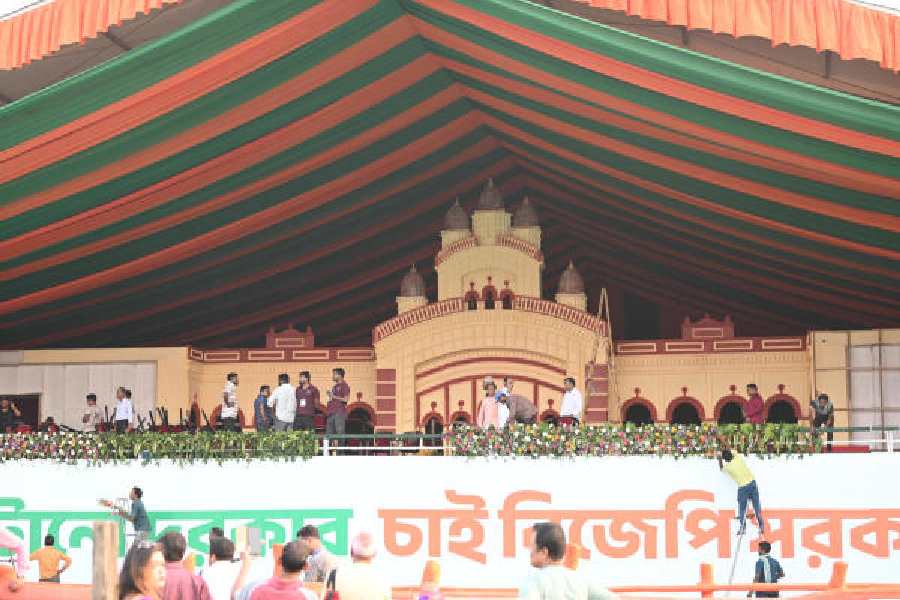
Perhaps the most telling political signal is not in the speeches, but in the stage design itself.
The massive stage at Brigade, measuring about 120 feet by 70 feet, has been crafted with unmistakable Bengali cultural motifs. The backdrop features the Dakshineswar Kali Temple and an image of Maa Kali. Traditional shola artwork is being used to recreate the temple’s feel, and the sides of the stage highlight Bengal’s art, culture and heritage.
What is missing is equally important: the familiar slogan “Jai Shri Ram” – a phrase that has become synonymous with the BJP’s politics in Bengal in recent years – is nowhere to be seen on the Prime Minister’s stage.
Political observers see this as a clear attempt to pivot towards Bengali identity politics. The BJP, often accused by its opponents of being an “outsider” force, appears to be consciously wrapping itself in the iconography of Bengal – invoking Maa Kali, projecting Dakshineswar, and emphasising local culture.
In other words, the party seems to realise that a Delhi‑designed Hindutva script alone may not be enough to win Bengal. The message is obvious: when “Jai Shri Ram” hits resistance on the streets, the BJP is quick to discover Maa Kali for electoral convenience.
Outsiders filling the heart of Kolkata
If the visuals from Howrah and Sealdah are any indication, this rally is not simply about gathering supporters from neighbouring neighbourhoods. Camps have been set up in and around the stations, as well as at the BJP’s old state office on Murlidhar Sen Lane, to provide food and accommodation to those being brought in from Bihar, Jharkhand, Odisha and North Bengal.
From North Bengal alone, the party is aiming to bring at least 50,000 workers and supporters to Kolkata. More than ten special trains have reportedly been arranged from Cooch Behar, New Jalpaiguri and Malda.
State BJP leaders – including Bhupender Yadav, Sunil Bansal, Samik Bhattacharya, Suvendu Adhikari and Sukanta Majumdar – have been camping at Brigade, repeatedly inspecting preparations and fine‑tuning the arrangements. The effort is enormous, but the political question refuses to go away: if the BJP truly has a strong, organically built base in Bengal, why does filling Brigade require such a massive import of people from outside the core urban and semi‑urban regions of South Bengal?
Claims, counters and the politics of numbers
Suvendu Adhikari has claimed that five lakh people will attend the rally. Samik Bhattacharya has gone further, speaking of a “massive public surge”. Such claims are not new in Indian politics; every big rally comes with inflated numbers.
But in this case, the BJP’s own insecurity is visible in the extent of logistical planning. Numbers alone do not prove political depth, especially when those numbers are boosted by special trains, hired buses and a state‑like mobilisation machinery. The real test of organisational strength is the ability to mobilise local voters and volunteers without turning a political rally into a tourist convoy.
Security, optics and the battle for narrative
Around 3,000 police personnel are being deployed in Kolkata for the Prime Minister’s security. The Brigade area has been divided into multiple sectors, each under the charge of a Deputy Commissioner‑rank officer. This heavy security cover is standard for a PM visit, but it also adds to the visual drama: barricades, metal detectors, security checks and a sea of uniformed personnel surrounding the stage.
For the BJP, however, security is only one part of the story. The bigger battle is for narrative. If aerial shots show a packed Brigade, the party will claim a psychological victory and project it as evidence that Bengal is ready for ‘parivartan’. If empty patches are visible, opponents will immediately label the rally as another inflated event propped up by outsiders.
Whatever happens, the symbolism of this day is unmistakable. You have a Prime Minister giving only a couple of hours to Kolkata, a party struggling to translate central power into local presence, and a stage that quietly drops “Jai Shri Ram” to embrace Maa Kali. The BJP wants to look like a natural, rooted force in Bengal – but the trains arriving from other states tell a more complicated story.
In the end, the real verdict will not be delivered at Brigade, but at the ballot box. Today’s rally may fill the ground. Whether it can fill the political vacuum the BJP still faces in large parts of Bengal is a very different question.