



RN Ravi Takes Charge: Can Bengal’s New Governor Reset Ties with Mamata?
When RN Ravi took oath as the 22nd Governor of West Bengal on a Thursday morning at Kolkata’s Raj Bhavan (now officially Lok Bhavan), it wasn’t just a constitutional formality. It was the beginning of a new chapter in one of India’s most politically charged relationships: that between the state’s Trinamool Congress government and the occupant of the Raj Bhavan.
A Ceremony Loaded with Subtext
On paper, the event was simple. Justice Sujoy Pal of the Calcutta High Court administered the oath to Ravi in the presence of Chief Minister Mamata Banerjee, Assembly Speaker Biman Banerjee, Left Front chairman Biman Bose, Kolkata Mayor Firhad Hakim and top bureaucrats including Chief Secretary Nandini Chakraborty.
But in Bengal, symbolism is everything.
The absence of an official BJP delegation from the ceremony was noticeable. The only face from the party mentioned was Anirban Ganguly, who attended not as a party representative but reportedly on the basis of a personal invitation from the Governor. This small detail itself highlights how layered and personalised the power dynamics in Bengal can be.
From Tea Circle to Direct Conversation
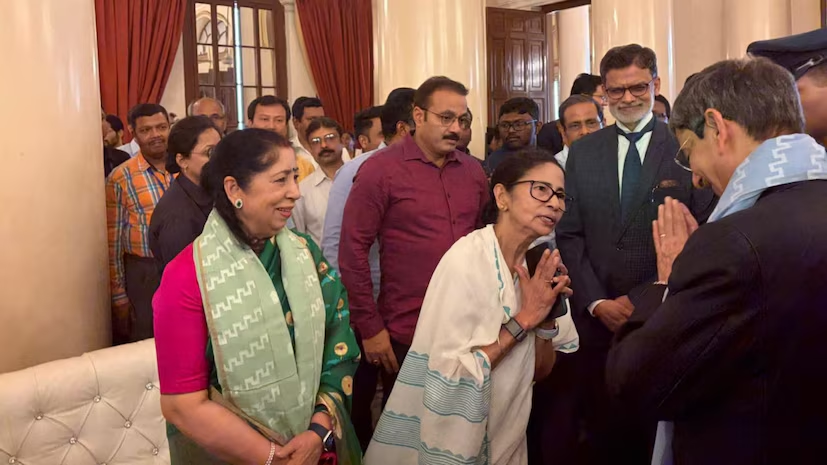
One of the most telling moments came not on the main stage, but on the sidelines. According to reports, after the national song Vande Mataram and the national anthem Jana Gana Mana were played and the oath-taking concluded, Ravi mingled with guests and joined a tea gathering.
At the same time, Mamata Banerjee was seen greeting other guests. When she began moving towards the tea circle, it was the Governor who walked up to her instead. This seemingly casual gesture carries political weight.
Mamata reportedly told him, “I know you and your family. Look at Bengal. Look at Bengal’s culture.” She then welcomed him by draping an uttariyo (a traditional shawl) around his shoulders.
In a state where the Raj Bhavan has often been perceived as an extension of Delhi’s political will, Mamata’s choice of words was sharp but polite: an invitation and a reminder rolled into one. “Look at Bengal. Look at Bengal’s culture” can also be read as “Respect Bengal’s mandate and its unique political context.”
A New Face, A Familiar Script?
RN Ravi is not an unknown figure in India’s political and security establishment. Before arriving in Kolkata, he had already served as Governor of Nagaland, Meghalaya and Tamil Nadu. He has been Deputy to National Security Adviser Ajit Doval and has headed the Intelligence Bureau as well. In Delhi’s power circles, Ravi is seen as a trusted, hardline, no-nonsense administrator.
That reputation is both an asset and a warning sign for Bengal.
In Nagaland, the Centre was reportedly satisfied with his handling of complex security and insurgency-related issues. In Tamil Nadu, however, his frequent run-ins with the MK Stalin-led DMK government often dominated headlines. Allegations of delays in assenting to bills, controversial public remarks and repeated confrontations turned the Tamil Nadu Raj Bhavan into a permanent flashpoint.
West Bengal is no stranger to this script. The state’s recent political history is full of Governor–Chief Minister clashes, from Jagdeep Dhankhar to C V Ananda Bose. The Raj Bhavan’s press releases, tweets and statements have regularly become political talking points.
Mamata’s Unease Was Already Public
Interestingly, Mamata Banerjee had already expressed her discomfort the moment RN Ravi’s name started doing the rounds as West Bengal’s next Governor. After the abrupt resignation of former Governor C V Ananda Bose, she wrote on social media that she was “stunned and deeply concerned” by the sudden development.
She also pointedly mentioned that she had no clarity about why Bose resigned at that moment. Coming from a Chief Minister who has been in near-constant friction with the Raj Bhavan, this statement was more than just a formal reaction – it was a signal of mistrust towards the entire process.
So when Ravi finally landed in Kolkata and took oath, the political backdrop was already tense.
The BJP’s Silent Message
Officially, the BJP did not send a delegation to the ceremony. In a state where optics matter almost as much as actual governance, this is intriguing. Was it a strategic decision to keep the spotlight on the new Governor and the Chief Minister, without crowding the frame with state BJP leaders? Or was it another way of signalling that the BJP prefers to act through institutional posts rather than frontal political attacks at this particular moment?
Whatever the reason, the absence allowed the Raj Bhavan–Nabanna equation to dominate the narrative, instead of turning the event into a party versus party spectacle.
Can RN Ravi Change the Tone?
The real question now is not who attended the ceremony, but how RN Ravi will approach the Governor’s role in a state like West Bengal.
There are two possible paths:
- The Tamil Nadu Template: A confrontational approach, frequent public disagreements with the elected government, delays over bills and ordinances, and constant political theatre around the Governor’s office.
- A Cooperative Reset: A more restrained, constitutional, back-channel-driven style where differences are handled away from cameras, and public friction is minimised.
Mamata’s welcome – polite, culturally rooted and subtly assertive – was an early invitation for the second path. “See Bengal, see Bengal’s culture” was not just about festivals and food, it was about acknowledging a politically aware society that prizes its own federal identity.
What This Means for Federal Politics
The appointment of RN Ravi must also be seen in the broader context of Centre–State relations in India.
For several opposition-ruled states – including West Bengal, Tamil Nadu, Kerala and Delhi – the Governor’s office is often viewed as the Centre’s remote control. Accusations of overreach, selective activism and political bias are common. Each new appointment or transfer of a Governor, therefore, is not treated as routine bureaucracy but as a major political move.
In Bengal’s case, this becomes even more sensitive with Lok Sabha elections, state-level polarisation, issues of law and order, and recurring flashpoints over central agencies and federal powers.
A Governor with a strong security and intelligence background can either:
- deepen mutual suspicion, or
- use that experience to build trust, ensure smoother Centre–State coordination and lower political temperatures.
Which way things go will depend as much on Nabanna as on Lok Bhavan, as much on Mamata Banerjee’s political instincts as on RN Ravi’s administrative style.
My Take: Early Days, But Signals Matter
At first glance, the visuals from the oath-taking suggest a cautious reset rather than outright hostility. There were no public fireworks, no sharp comments, no snubs on stage. The Governor walking towards the Chief Minister, and Mamata responding with traditional courtesy, are not game-changing actions – but they do matter symbolically.
However, Bengal’s politics is not shaped in drawing rooms and tea circles alone. The fault lines are deep – from clashes over law and order and central funds to ongoing political-ideological battles between the BJP and Trinamool Congress.
If RN Ravi chooses to play a visibly activist, hyper-political role, we could see a repeat of the Tamil Nadu-style confrontation, this time in a state that is already on edge. If he chooses a quieter, procedural and constitution-focused role, this may actually help cool down one of India’s most intense Centre–State feuds.
For now, one thing is clear: the oath ceremony was not just a change of nameplate at Lok Bhavan. It was a carefully choreographed opening act of a political play whose real drama is yet to unfold.
As citizens and observers, we should pay close attention – not just to the headlines, but to the nuances: who walks towards whom, who speaks first, who remains silent, and how Bengal’s culture and mandate are respected in practice, not just in polite words over tea.


