



10 Promises in TMC’s 2026 Manifesto: Mamata Banerjee Unveils Plan for 7 New Districts in Bengal
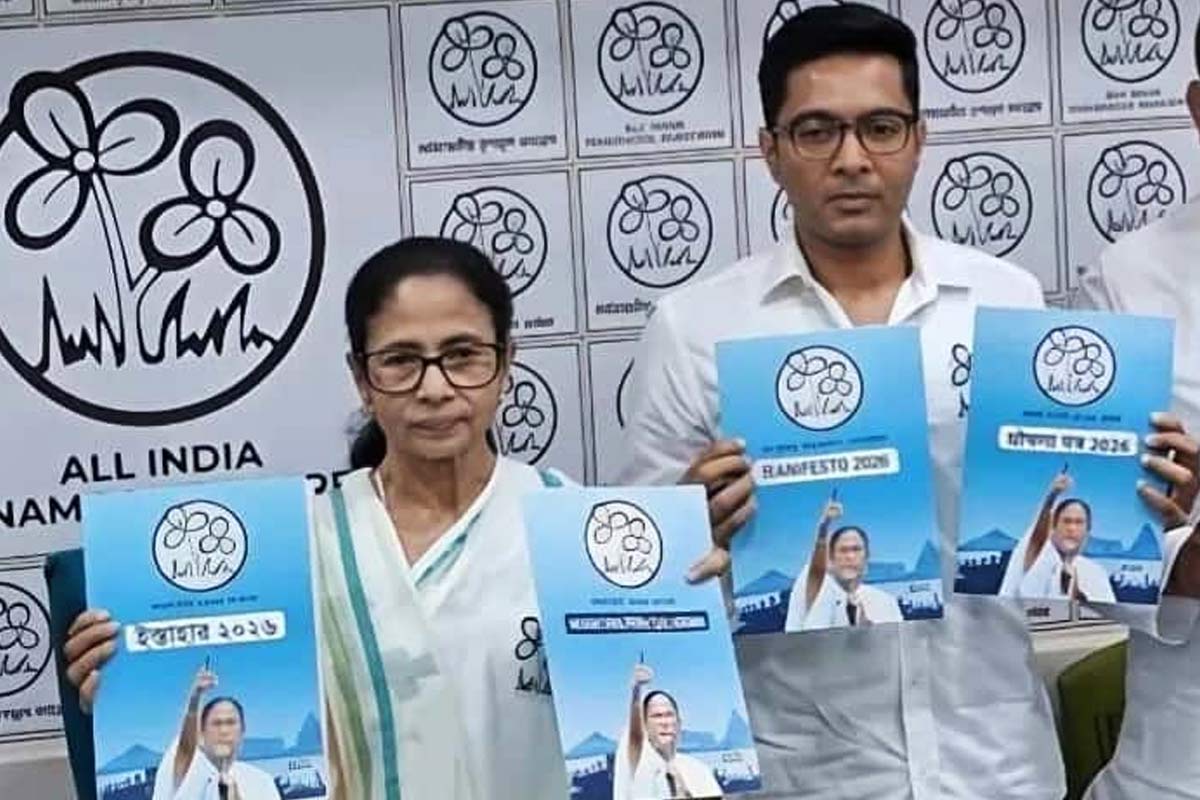
The Trinamool Congress (TMC) has officially sounded the bugle for the 2026 West Bengal Assembly election with the release of its new manifesto, titled “Pratigya” (The Pledge). Party supremo and Chief Minister Mamata Banerjee unveiled the document on Friday evening, with TMC’s All India General Secretary Abhishek Banerjee by her side.
Framed as a roadmap for the “next phase” of governance in Bengal, the manifesto puts strong emphasis on administrative restructuring, jobs, healthcare, education and basic services.
7 New Districts: A Major Administrative Reshuffle
One of the most striking announcements in the TMC manifesto is the decision to create 7 new districts in West Bengal. According to the party, this move is aimed at improving governance and reducing the load on existing district administrations.
As per the manifesto, the proposed new districts are:
- Kandi
- Behrampore (Baharampur)
- Bishnupur
- Sundarban
- Ranaghat
- Ichhamati
- Basirhat
The TMC argues that smaller, more focused districts will make delivery of government services faster and more efficient, especially in regions that have unique geographic or socio-economic challenges.
Along with new districts, the manifesto also talks about comprehensive geographical reorganisation, which includes an increase in the number of municipalities and urban local bodies. The stated objective is to strengthen urban governance and ensure that growing towns receive the infrastructure and services they need.
Jobs and Livelihood: Promise of 10 Lakh Employment Opportunities
The manifesto promises 10 lakh (1 million) employment opportunities in the coming years. While detailed sector-wise breakups are not fully elaborated in the brief, the TMC indicates that these jobs will emerge from:
- Public infrastructure projects
- Expansion of social welfare schemes
- Growth in education and healthcare sectors
- Support to small businesses and local industries
By placing job creation at the centre of its pitch, the party is clearly trying to address the concerns of youth and unemployed graduates, a crucial voter segment in every Assembly election.
‘Pratigya’: 10 Core Commitments
The 2026 manifesto, named “Pratigya”, is structured around 10 core commitments. While the full text lists multiple schemes and targets, the key themes that stand out include:
- Administrative Decentralisation – Creation of 7 new districts and expansion of municipalities to bring governance closer to people.
- Employment Generation – Promise of 10 lakh employment opportunities across various sectors.
- Door-to-Door Healthcare – Launch of the ‘Duare Chikitsa’ (Healthcare at the Doorstep) service.
- Strengthening Duare Sarkar – Continuation and expansion of the existing Duare Sarkar outreach camps.
- Healthcare Access for All – Reinforcement of existing schemes like Swasthya Sathi, with more ambulances and better emergency care.
- Education & Modernisation of Schools – Upgradation of thousands of schools with modern infrastructure, technology and e-learning tools.
- Safe Drinking Water for Every Family – Commitment to provide drinking water to every ordinary household.
- Housing Support – Continued support for home construction for the poor and vulnerable.
- Urban and Rural Infrastructure – Better roads, civic amenities, and local infrastructure in both urban and rural areas.
- Social Security and Welfare – Strengthening welfare schemes for women, children, farmers and marginalised communities.
The manifesto presents these as a continuation of existing governance rather than a complete reset, emphasising that the TMC government wants to “take the next step forward” based on what it describes as past achievements.
‘Duare Chikitsa’: Door-to-Door Healthcare After ‘Duare Sarkar’
Mamata Banerjee, highlighting her government’s healthcare record, announced a new initiative: ‘Duare Chikitsa’ (Healthcare at the Doorstep).
She stated that the popular ‘Duare Sarkar’ (Government at the Doorstep) camps, which have been used to deliver various government services directly to citizens, will continue. On top of this, the new healthcare outreach will focus specifically on:
- Primary medical check-ups at the local level
- Health camps in neighbourhoods and villages
- Strengthening the linkage with existing schemes like Swasthya Sathi
- Improving ambulance availability, including those supported by MP LAD funds, which have already contributed hundreds of ambulances
According to the TMC, this model is meant to ensure that no citizen is left behind due to distance or poverty when it comes to basic healthcare.
Education: Modernising Thousands of Schools
Another major pillar of the manifesto is education. Mamata Banerjee stressed that the government will focus on the modernisation of thousands of schools across West Bengal.
The proposals include:
- Upgrading infrastructure in government schools
- Introducing or expanding e-learning facilities
- Integrating modern technology into classrooms
- Ensuring that the right to education reaches every child in Bengal
The manifesto positions education reform as essential for long-term employment and social mobility, linking it to the broader promise of job creation.
Water, Housing and Basic Services
Beyond big-ticket announcements like new districts and healthcare schemes, the manifesto devotes space to basic services that directly affect everyday life:
- Drinking Water: A commitment to supply safe drinking water to every ordinary family in the state.
- Housing: Continued emphasis on support for house construction for those who do not have secure shelter.
- Civic Services: With the proposed increase in the number of municipalities, the TMC says it aims to improve solid waste management, drainage, roads and street lighting in towns and semi-urban regions.
These promises are framed as part of the party’s long-term effort to strengthen grassroots development.
Political Context: Campaigning Gathers Pace
Even before the manifesto release, TMC candidates had begun active campaigning across the state. The party’s star campaigners, including Mamata Banerjee and Abhishek Banerjee, are expected to intensify their outreach in the coming days.
The “Pratigya” manifesto thus acts as the central political document around which the TMC plans to build its narrative for the 2026 West Bengal Assembly Election—focusing on continuity, welfare schemes, administrative reform and expansion of services.
Opposition parties are expected to scrutinise these promises closely, particularly on questions of implementation, funding and employment outcomes. For now, however, the TMC’s strategy is clear: project itself as a party that has delivered in the past and is ready with a detailed, pledge-based agenda for the next term.