


Iran has now categorically denied that any special concession was granted to Indian‑flagged ships in the highly sensitive Strait of Hormuz. In one stroke, Tehran has punctured the narrative that New Delhi’s diplomacy had secured safe passage for Indian tankers amid the ongoing US‑Iran and Israel‑Iran confrontation.
For hours, Indian media and strategic circles were abuzz with claims that External Affairs Minister S. Jaishankar had spoken to his Iranian counterpart, Abbas Araghchi, and that this had resulted in permission for Indian‑flagged vessels to move through the Strait. Tehran’s official clarification has thrown cold water on those claims.
According to Iranian authorities, no ‘special arrangement’ or separate protocol has been offered to India. They have termed the reports of an exclusive understanding as misleading and stated that any vessel entering the Strait of Hormuz must seek prior permission. Failing that, Iran has warned, there could be direct military consequences.
This blunt message from Tehran exposes the uncomfortable reality for India: despite public posturing and back‑channel outreach, New Delhi does not enjoy the kind of assured immunity for its commercial shipping that some in the establishment were eager to project.
Strategic Chokepoint, Political Embarrassment
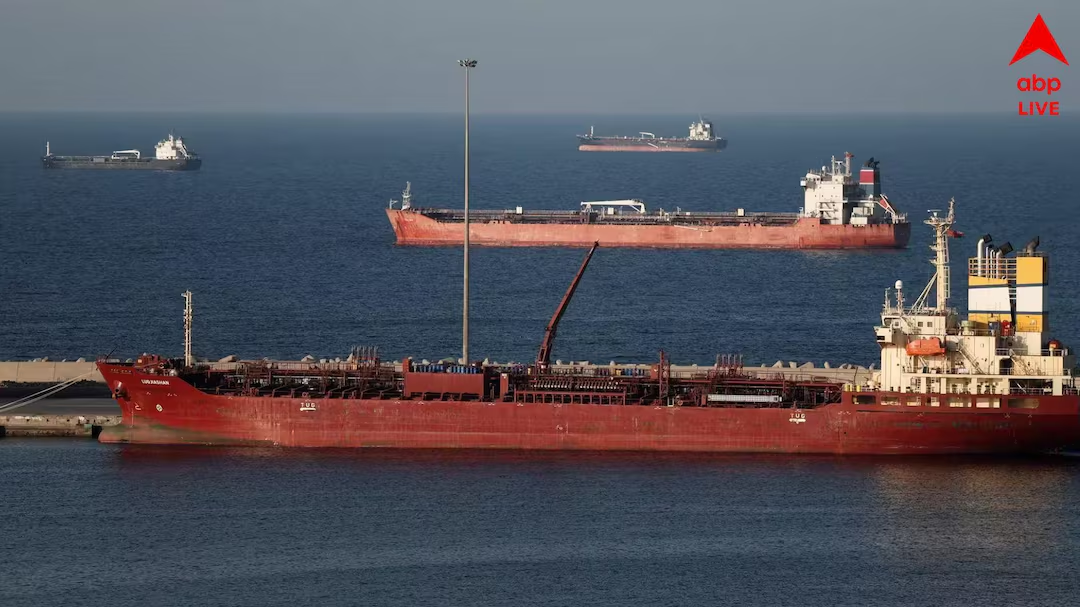
The Strait of Hormuz, a 55‑kilometre‑wide corridor between Iran and Oman, separates the Persian Gulf from the Arabian Sea. It is one of the world’s most critical energy chokepoints. Nearly 13 million barrels of oil pass through this narrow waterway every single day – around 31% of global oil supply – besides substantial volumes of natural gas.
Any disruption here has a direct bearing on Iraq, Kuwait, Saudi Arabia, the UAE and Iran itself. For an energy‑dependent country like India, the stakes are even higher: soaring prices, supply insecurity and domestic political pressure over fuel and LPG costs.
Yet, despite these high stakes, Iran has drawn a clear red line. It has reiterated that there is no blanket assurance for Indian ships. Earlier, Tehran had publicly said that vessels flying the flags of India, China and Russia would not be targeted, in contrast to ships linked to the US, Europe and Israel. Now, however, Iran has clarified that this does not translate into an open‑ended, unconditional safe passage agreement.
As of now, 28 Indian‑flagged vessels are believed to be operating in and around the Strait of Hormuz, with 778 Indian seafarers on board. Each new statement from Tehran heightens anxiety among shipping companies and families of crew members, and raises pointed questions about whether New Delhi has actually secured anything substantial beyond verbal assurances.
The Gujarat‑Bound Attack And Mixed Signals
Even as Iran sought to reassure that Indian‑flagged ships would not be attacked, a Gujarat‑bound vessel came under strike just a day earlier. This contradiction is at the heart of the current diplomatic discomfort: India is trying to walk a tightrope, but the ground reality in the war zone is shifting by the hour.
Amid this uncertainty, a Liberia‑flagged ship with Indian crew, carrying Saudi crude, recently managed to dock safely in Mumbai after crossing the Strait of Hormuz. It was reported as the first vessel to complete such a journey in the new war environment. News agency IANS reported that two tankers, ‘Pushpak’ and ‘Parimal’, crossed the Strait safely, even as American, European and Israeli‑linked vessels remained effectively stranded.
This partial success was quickly showcased in some quarters as proof that India’s diplomacy was ‘working’. The suggestion that Jaishankar’s telephonic outreach to Iran had melted the ice and opened the sea lane for Indian interests was politically convenient – until Tehran publicly contradicted it.
Iran’s Firm Stand And India’s Tightrope Walk
Tehran’s latest communication leaves little room for optimistic spin. It has asserted that:
- No special corridor has been carved out for India.
- All ships, irrespective of flag, must seek prior approval before entering the Strait.
- Iran reserves the right to take military action if vessels violate these conditions.
For India, this is more than a shipping issue; it is a test of strategic autonomy. New Delhi has tried to balance relationships with the US, Israel, Gulf monarchies, Russia and Iran for years. The current conflict has brutally exposed how fragile that balance can be when hard military power and energy routes are on the line.
India’s visible proximity to the US‑Israel axis in recent years, coupled with Western expectations that New Delhi will align more closely with their sanctions regimes, has not gone unnoticed in Tehran. At the same time, India cannot afford to alienate Iran, which remains a crucial energy supplier and a key node for connectivity to Central Asia and Afghanistan.
The denial of any special shipping arrangement signals that Iran is unwilling to give India a free pass while it is locked in a high‑stakes confrontation with Washington and Tel Aviv.
Domestic Fallout: Energy Prices And Political Heat
Back home, the geopolitical tension in the Strait of Hormuz is being acutely felt in Indian kitchens and factories. Any prolonged disruption in oil and gas flows from the Gulf region threatens to:
- Push up petrol, diesel and LPG prices,
- Fuel inflation across essential commodities,
- Intensify public anger over cost of living, and
- Put the central government under political pressure ahead of elections and state polls.
Already, concerns around LPG availability and pricing have sparked agitation and criticism. If the crisis deepens, India’s dependence on imported energy could become a major point of attack for the Opposition, which is likely to question both the government’s foreign policy choices and its domestic preparedness for such shocks.
The narrative that India’s ‘strong diplomacy’ had shielded its tankers from the fallout of the US‑Iran confrontation offered a politically convenient cushion. Iran’s categorical denial has effectively torn that cushion away.
Shipping Uncertainty And Seafarer Safety
Shipping companies operating Indian‑flagged vessels are now caught in a web of conflicting signals. On the one hand, they are told that Indian ships will not be targeted. On the other, they are warned that entry without prior permission could invite military action.
This ambiguity creates:
- Operational risk for ships,
- Legal and insurance complications,
- And emotional stress for the families of the 778 Indian seafarers currently in the region.
Experts point out that without a clear, written understanding or a transparent corridor arrangement, India’s shipping sector is essentially navigating on hope and ad hoc permissions – an unsustainable model in a live conflict zone.
A Test Case For India’s Foreign Policy
The Strait of Hormuz crisis has become a live test case for India’s claim of being a ‘Vishwaguru’ and a rising global power capable of defending its interests in contested spaces.
Key questions now arise:
- If India is truly a leading power, why is there no clear, binding assurance for the safety of its commercial shipping?
- Has New Delhi over‑relied on silent back‑channel diplomacy while allowing public narratives of ‘special treatment’ to grow unchecked?
- Is India prepared for a prolonged energy shock if the Strait remains effectively weaponised by Iran in its confrontation with the US and Israel?
Iran’s firm stand suggests that, in a theatre where missiles and drones speak louder than statements, even major emerging powers like India will have to work much harder to secure concrete guarantees.
For now, Tehran’s denial has exposed the limits of India’s leverage – and reminded New Delhi that in the brutal calculus of war, friendly rhetoric and real concessions are not the same thing.
About the Author: Pompa Adhikari Singh
A student of English literature and journalism, Pompa Adhikari Singh has been working in journalism for over 11 years. She writes on politics and international relations, with a special interest in how global conflicts shape India’s domestic debates.