



ECI’s New Burqa Rule: Security Measure or Targeted Message?
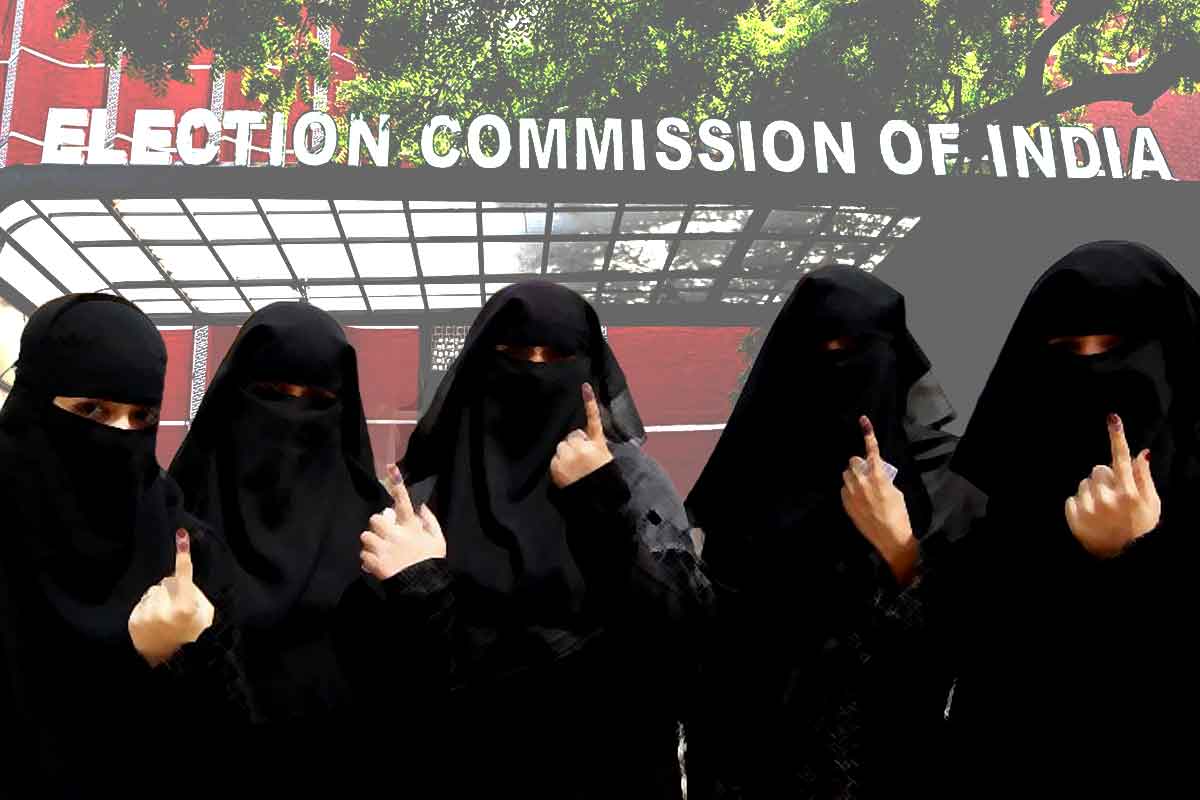
The Election Commission of India (ECI), under the watch of Jagnesh Kumar, has decided that simply standing in the polling queue wearing a burqa will no longer be enough for Muslim women in West Bengal. Before they can cast their vote, they must go to a separate, designated counter outside the booth, remove their face covering, and allow polling staff to match their face with their photo ID.
On paper, the Commission presents this as a basic verification step. In practice, it is a politically explosive move in a state where Muslim women constitute a substantial and highly contested vote bank.
This rule, inspired by the “Bihar model”, introduces an extra layer of procedure only for women who cover their faces. They must:
- Step out of the general voting queue.
- Go to a dedicated counter outside the booth.
- Uncover their face and show it with their identity card.
- Return to the process only after officials are satisfied.
The question is not whether identity verification is needed – it always has been. The question is: why is this community-specific “solution” being aggressively pushed now, just months before a crucial Assembly election in a politically sensitive state like West Bengal?
Minority Voters Under the Lens
The ECI’s current posture in Bengal is not limited to the burqa rule. Even before this directive, the Commission had already drawn criticism for its intense, area-wise “correction” of the voter list, which appears to have fallen disproportionately on minority-heavy pockets.
According to the final voter list published on 28 February, nearly 60 lakh voters have been marked as “under trial” or “disputed” — a massive number by any standard. By Friday night, about 15 lakh of these cases were reportedly resolved, with more resolutions expected and partial lists to be published in phases over the coming weeks.
Legally, the process may be backed by the Supreme Court–appointed judicial officers who are scrutinising these cases. Politically, however, the optics are unmistakable: just ahead of the 2026 Assembly polls, lakhs of voters are being kept in a zone of uncertainty, with minorities feeling they are once again on the frontline of “electoral cleansing”.
The Commission itself admits it is carefully watching whether the burqa directive will be acceptable to minority communities. That admission is telling: it knows this is not a neutral administrative tweak, but a high-voltage political signal.
Ban on Under-Trial Candidates: Cleaning Politics or Narrowing Democracy?
In another sharp move, the Election Commission has clearly stated that any person whose case is still under trial will not be allowed to file nomination papers until their case is resolved.
With 60 lakh voters tagged as “under trial” in the list released on 28 February, this is not a minor technicality. It has direct implications for parties and leaders in areas where cases are often filed on political grounds.
The current framework looks like this:
- Under-trial individuals cannot file nominations until their cases are disposed of.
- Supreme Court–appointed judicial officers are examining these cases.
- Partial, updated lists will be released in stages.
- Those who are excluded can appeal through channels opened by the court.
- If a person is rejected by the judges, they will then have to approach a tribunal.
The catch: no one knows when the tribunal will be formed. In real-world terms, that likely means a large number of under-trial individuals will be unable to contest in the 2026 Assembly election.
Again, while this is framed as a step towards “clean politics”, in a state with a long history of politically motivated cases against opposition leaders and activists, the decision risks becoming a tool that narrows democratic choice rather than deepens it.
Importing the ‘Bihar Model’: A Convenient Template
The Commission has also signalled its intention to introduce certain rules from Bihar into West Bengal’s election process.
In Bihar, every polling booth has a separate counter. Any woman who arrives with her face covered must go to that counter, reveal her face by lifting her veil or removing her face covering, and only then is she allowed to cast her vote.
Now, West Bengal is set to see a similar system:
- A separate identity verification counter at or outside every booth.
- Burqa-clad or face-covered women must remove their face covering at that counter to match their identity with their voter ID.
- Only after this verification will they be cleared to vote.
At the same time, the Commission is also considering home-voting for senior citizens and specially-abled voters – a move that appears voter-friendly and progressive. It is this combination that makes the strategy interesting: a soft, inclusive message for some sections, coupled with a visibly strict, almost intrusive stance towards a particular religious group’s women.
Is This About Fraud Prevention or Voter Suppression?
Supporters of the ECI’s new line argue that:
- Face verification is essential to prevent bogus voting.
- Separate counters offer a “dignified” way to carry out the process without chaos inside the booth.
- Under-trial candidates contesting elections dilute public trust in democracy.
However, critics – especially in Bengal’s minority and civil rights circles – see a more troubling pattern:
-
Disproportionate Targeting of One Community
The additional layer of scrutiny clearly falls on burqa-clad Muslim women. For many, this is less about fraud and more about sending a message that their identity itself is suspicious unless repeatedly proven otherwise. -
Chilling Effect on Participation
Not every woman is comfortable unveiling in front of strangers, even if polling staff include women. The fear of embarrassment, confusion or confrontation may be enough to discourage some from voting at all. -
Weaponising the ‘Under-Trial’ Label
In a system where cases are frequently slapped on activists and political workers, labelling someone “under trial” and then using that label to block their candidature can be deeply anti-democratic, even if technically legal. -
Timing Before a High-Stakes Election
These rules are not being introduced in a vacuum; they come just as parties in West Bengal are sharpening their strategies to mobilise or fracture the minority vote.
The Larger Battle: Controlling the Minority Vote Bank
West Bengal’s politics over the last decade has been defined by intense competition for the minority vote. For the ruling party, consolidating Muslim support is critical. For the opposition, denting that consolidation by any means is a political necessity.
In this context, the Election Commission’s decisions cannot be viewed as isolated, value-neutral administrative actions. They sit squarely inside a larger struggle over who controls – and who intimidates – the Muslim electorate.
The narrative is already being shaped along predictable lines:
- One camp will claim that the ECI is finally enforcing rules and discipline, bringing West Bengal in line with stricter states like Bihar.
- The other camp will present these moves as a slow, methodical attempt to police, stigmatise, and ultimately reduce the influence of minority voters.
The truth, as always, lies not in press releases but in lived experience on polling day: how many women turn back from the booths, how many under-trial leaders are prevented from contesting, and how many constituencies are effectively reshaped by these administrative decisions.
What This Means for Democracy in West Bengal
Elections are not just about EVMs, voter lists, and security forces. They are also about the invisible lines of trust between citizens and the institutions that claim to serve them.
When one community feels it is being singled out – forced to jump extra hurdles, stripped of the benefit of the doubt – that trust erodes.
The ECI might defend its actions as technically sound and legally justified. But democracy is not sustained by technicalities alone. It survives on the perception of fairness.
As the 2026 West Bengal Assembly Election approaches, the state is not just choosing a government. It is being forced to confront a deeper question: are we moving towards a more transparent democracy, or a more selective one where some voters are always more suspect than others?
The burqa counter and the disputed voter list may be framed as mere procedures. In reality, they could become defining symbols of how power views the minority citizen: not as an equal stakeholder, but as a problem to be managed.
In that sense, what happens at those “special counters” outside the polling booths of West Bengal will tell us far more about the health of Indian democracy than any victory speech on counting day.