





2-phase voting in Bengal: Is it really ‘unprecedented’?
In the history of Bengal politics, the 2026 Assembly election will remain a major turning point. For the first time in nearly 25 years, voting in West Bengal will be held in just two phases. For years, we’ve been used to multi-phase elections — 5 phases in 2006, 6 in 2011, 7 in 2016, and a record 8 phases in 2021. In that context, this shift can undoubtedly be called unprecedented.
The question is simple: is this merely a logistical calculation, or is there a deeper political calculation hidden behind it?
Dates, seats, and ground reality: What does the schedule say?
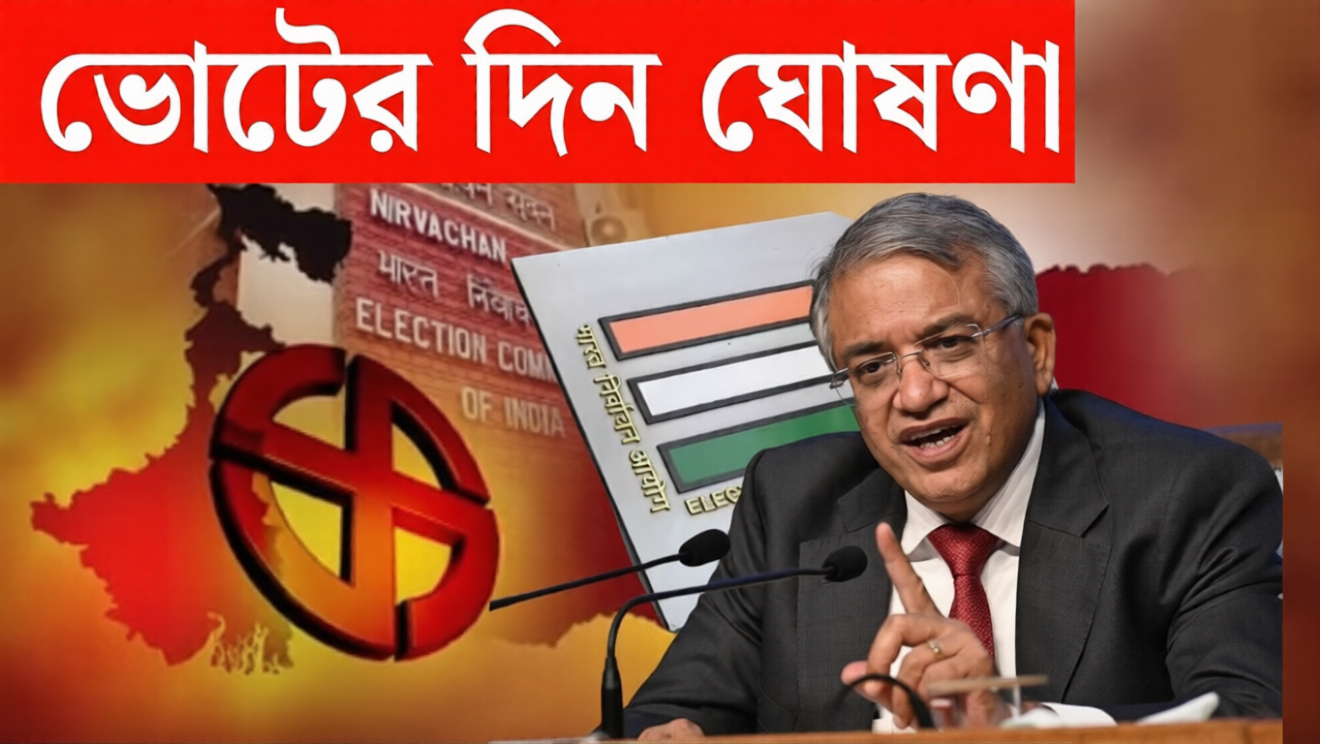
According to the schedule announced by the Election Commission:
-
First phase of polling: 23 April
Number of seats: 152 -
Second phase of polling: 29 April
Number of seats: 142 -
Result declaration: 4 May
In other words, the entire state will be divided into two large segments and voting will be completed within a week. From an administrative perspective, this is undoubtedly a very compact election plan. But will the quality of the democratic process be equally compact and efficient? This is where the battle of opinions begins.
Why were there so many phases for so many years?
The Election Commission’s reasoning has long been the same:
- West Bengal is a politically sensitive and volatile state.
- There is always a risk of political violence and clashes during elections.
- Deploying adequate central forces across the state and rotating them is not an easy task.
Because of this, since 2006, Assembly elections in Bengal have never been held in fewer than five phases. In fact, the number of phases has gradually increased. In the 8-phase election of 2021, we witnessed intense political heat, serious levels of violence, and a flood of allegations and counter-allegations.
So why this sudden change now? What has changed — Bengal itself, or the Commission’s assessment of Bengal?
The Commission’s message: Fewer phases, but ‘no compromise’ on security
Sources in the Commission say that even though the number of phases has come down, there will be no stinginess when it comes to security. Rather, keeping Bengal’s history of political violence in mind:
- There are plans to deploy a massive contingent of central security forces.
- Experienced observers will be present in each phase.
- The focus will be on ensuring free and peaceful polling.
The message is clear:
“Fewer phases does not mean less security.”
But the question remains — in practical political reality, is it really possible to deploy such large numbers of forces so quickly and simultaneously? And will that actually translate into a concrete sense of safety for voters on the ground?
2-phase voting: Who gains, who loses?
In this new equation, all political parties are wrestling with the same question — who benefits more from this schedule?
1. From the Trinamool Congress’s perspective
As the ruling party in the state, a shorter, 2-phase election can be advantageous for Trinamool in several ways:
- It’s easier to keep the administrative machinery under relatively consistent control over a shorter period.
- The kind of anti-incumbency narrative that gradually builds up in the media during a long, multi-phase election has much less time to grow.
- Instead of a prolonged campaign, the party can opt for an intense, high-voltage campaign within a compressed time window.
2. The BJP and the opposition’s equation
For opposition parties, long multi-phase elections often turn out to be beneficial because:
- After each phase, they can assess voting trends and tweak their campaign strategy.
- If there are incidents of violence or malpractice, they get more time and opportunity to build media pressure and shape public opinion against the ruling party.
A 2-phase election drastically reduces that scope for mid-course correction. So it’s natural that a section of the opposition might suspect that this schedule has been structured in a way that favours the ruling party.
As voters, what should our questions be?
We, the ordinary voters, often get busy with dates, phases, and candidate names. But the real questions lie much deeper:
- Does fewer phases automatically mean less violence?
- Does the presence of central forces guarantee that voters will feel safe at every booth?
- In rural Bengal, in border areas, in the hills — how confident are people that their vote is actually being cast and counted correctly?
The Commission says it is determined to conduct a free and peaceful election. But trust is not built on announcements alone; it is built on lived experience. So the 2026 election is not just a challenge for political parties, it is also a trial by fire for the Commission’s credibility.
Is Bengal moving out of the ‘multi-phase election’ era?
For the first time in 25 years, such a low number of phases in Bengal is not just a statistic; it can point towards two underlying signals:
- Signal One: The Commission genuinely believes that Bengal’s law-and-order situation is now much more under control than before, and therefore there is no need for so many phases.
- Signal Two: The long multi-phase election model has become so politically and administratively controversial that there was pressure from various quarters to move away from it.
These two explanations don’t entirely contradict each other. They can easily coexist. But from the standpoint of an ordinary citizen, the issue is quite simple:
“I should be able to vote without fear. My vote should be counted correctly.”
All other theories, strategies, and logistics become meaningful only after this one basic condition is met.
Conclusion: How should we read this signal of change?
The decision to hold the West Bengal Assembly Election 2026 in just 2 phases will be hailed by some as a bold step, and criticised by others as a risky experiment. But in a democracy, such decisions are ultimately judged in two places:
- At the polling booth on election day – how safe and empowered did people actually feel?
- In the public mind after the results – did people feel that the election was fair and transparent?
The core opinion of this blog is straightforward:
Whether the Bengal election happens in 2 phases or 8 — the number of phases is far less important than the quality of democracy, the dignity of the voter, and the real experience of security. If the Commission can truly deliver, as promised, massive deployment of forces, strict surveillance, and genuine neutrality, then this 2-phase model could go down in history as a positive turning point for Bengal’s democracy.
But if the old ghosts of violence, fear, and allegations return, people will undoubtedly question the legitimacy of this decision. That is the beauty of democracy — the final word always belongs to the voter.